Patriarchal Era
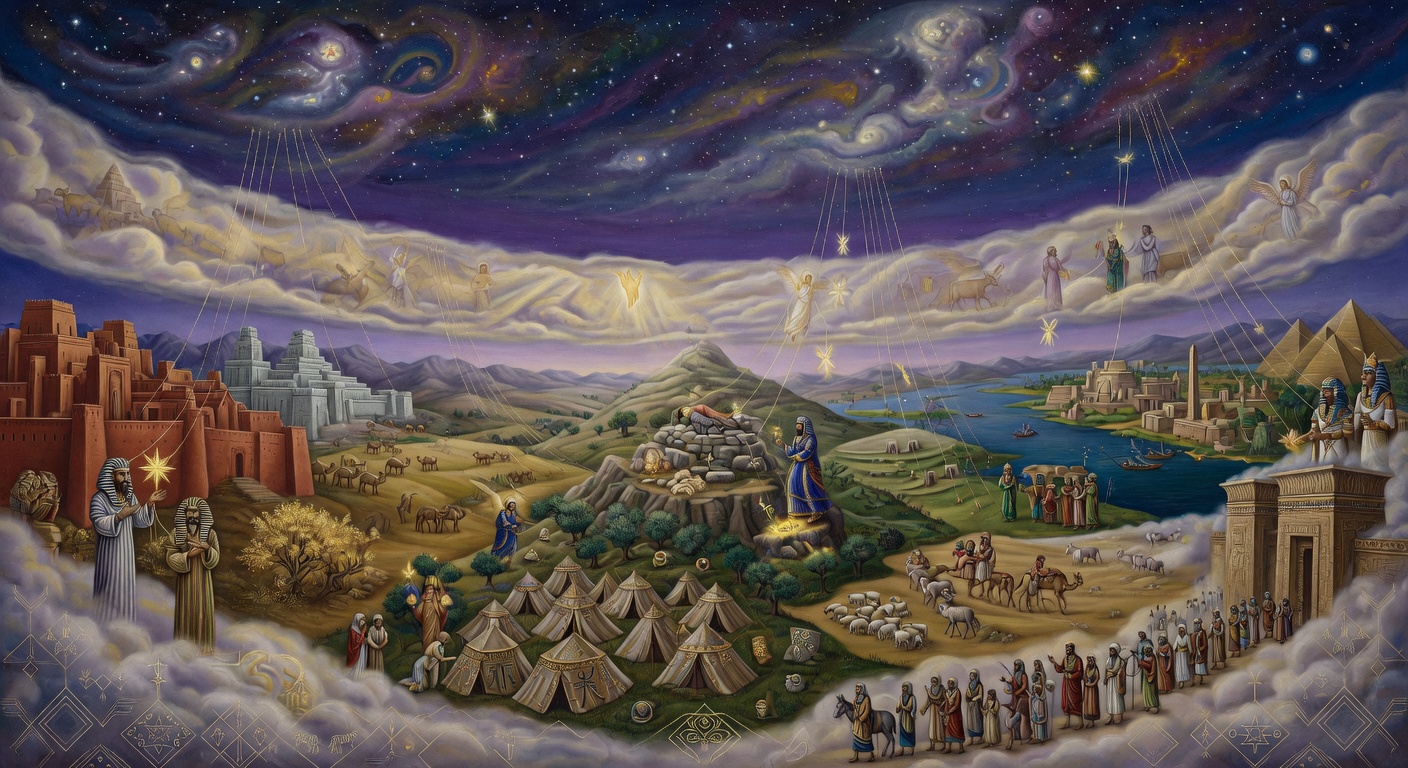
Following the upheavals of the flood and the scattering of nations, the ancient apocryphal writings portray a decisive turning point in sacred history when divine covenants were reestablished through a single family line descending from Shem. The Book of Jubilees, drawing heavily on Enochic chronology, situates Abraham’s call within a precise system of jubilees and weeks of years, recording how he rejected the idols of his father Terah and received promises of land and numerous descendants while dwelling first in Ur and then in Haran (Jubilees 11–12). These covenants, renewed at sacred sites such as the oak of Moreh and the altar near Bethel, frame the patriarchs’ movements between Canaan and Egypt as part of a larger divine plan to preserve righteousness amid surrounding nations. The narratives expand considerably in both Jubilees and the Book of Jasher, which supply extended accounts of Isaac’s birth and near-sacrifice, Jacob’s acquisition of the birthright and his years of service with Laban, and the complex family dynamics that culminate in Joseph’s betrayal by his brothers. Jasher 42–47, for instance, details the sale of Joseph into Egyptian slavery and his subsequent rise, while Jubilees 39–45 emphasizes the preservation of ritual purity and calendrical observance even in foreign lands. These episodes are not mere family history; within the Enochian worldview they illustrate the transmission of heavenly knowledge—books of astronomy, medicine, and law—down to the next generation, ensuring that the wisdom Enoch received from the angels would survive the coming judgments. The descent of Jacob’s household into Egypt marks the close of this era and sets the stage for the later oppression and exodus. In the Animal Apocalypse of 1 Enoch (chapters 89–90), the patriarchs appear symbolically as white bulls whose offspring gradually lose their original purity, signaling the onset of a new cycle of rebellion. Together these texts present the patriarchal period as a bridge between primeval revelation and the national story of Israel, underscoring the enduring authority of Enochic tradition in shaping how later generations understood covenant, exile, and return.
Books
The Book of Jubilees, The Book of Jasher
Did You Know?
Jubilees presents Abraham, Isaac, and Jacob as already observing the full Law before Sinai.
The patriarchs celebrate Tabernacles, Weeks, and other feasts centuries before Moses.
Jubilees presents the patriarchs as fully Torah-observant centuries before Sinai — law precedes Moses.
Abraham celebrates Tabernacles, Isaac keeps Weeks, Jacob observes Passover — all before the Exodus.
The patriarchal period spans exactly seven jubilees in the text's precise chronological framework.