Places
118 locations across the ancient world - cities, mountains, rivers, and regions where God's story unfolded.


Celestial
-
Heaven
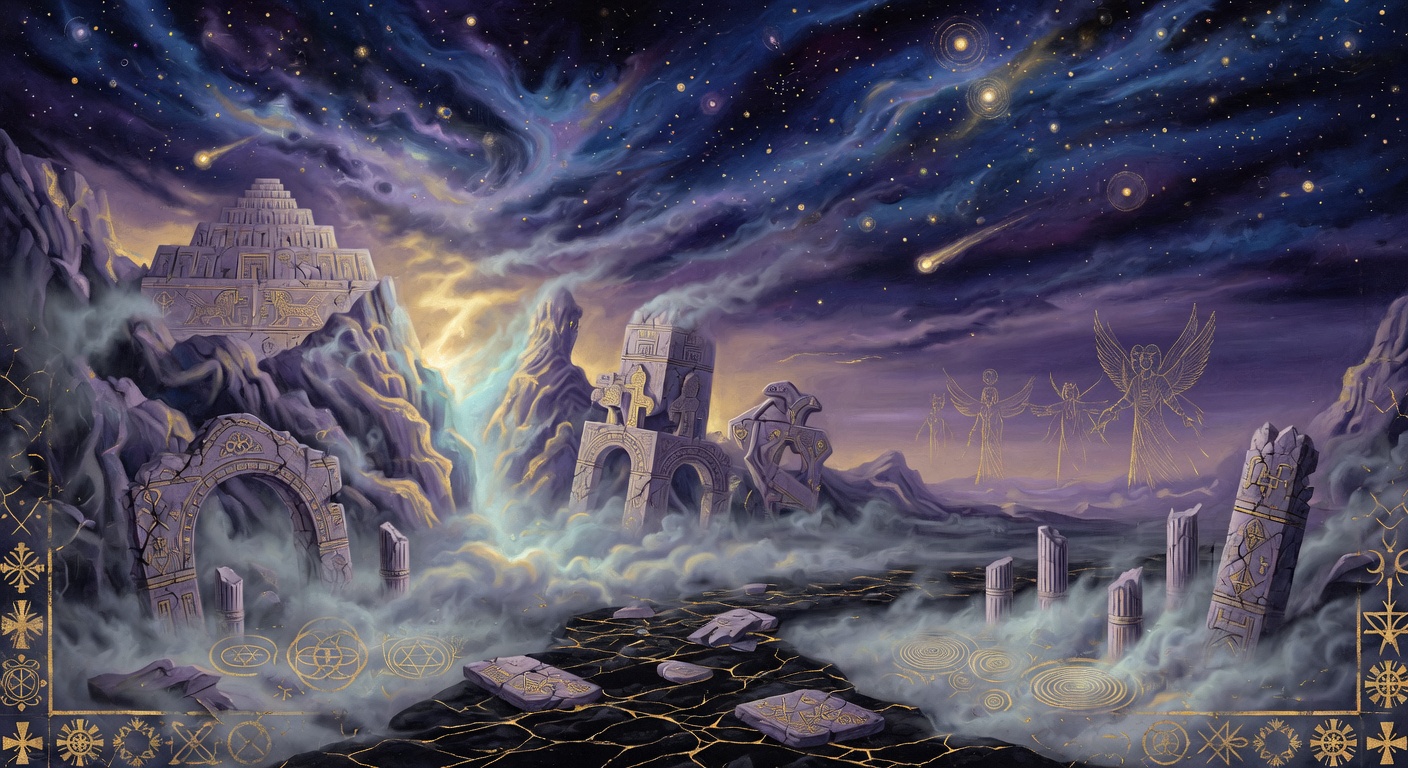
In the visionary accounts of the ancient Enochic literature, the celestial domain emerges as the divine seat of authority where the Lord of Spirits presides over creation and dispenses judgment. Enoch’s ascents, detailed most vividly in the Book of Watchers, portray this realm as a structured hierarchy of luminous palaces and fiery barriers that the seer must traverse. Chapter 14 recounts his passage through walls of crystal and tongues of fire before reaching the throne room itself, where the Great Glory sits upon a chariot throne surrounded by streams of fire, establishing heaven not merely as a distant abode but as the active center from which cosmic order flows. The texts further depict this realm as the dwelling place of countless angelic hosts organized into distinct orders, each entrusted with governance over natural phenomena and human affairs. In 1 Enoch 71, during the Similitudes, Enoch witnesses the “Head of Days” alongside the Elect One, surrounded by thousands upon thousands of holy ones whose ceaseless praise sustains the heavens. Jubilees 2 reinforces this picture by noting that the angels were created on the first day alongside the firmament, positioning heaven as the original locus of both worship and administrative oversight before any earthly temple existed. Such descriptions underscore the Enochian tradition’s emphasis on heaven as the source of revealed wisdom, where forbidden knowledge is both guarded and selectively disclosed to the righteous. Within these writings, the celestial realm also functions as the destined home for the spirits of the righteous after death and as the setting for final judgment. Enoch’s tours in chapters 17–36 and 41–44 reveal storehouses of meteorological phenomena, the paths of the stars, and the chambers holding the souls of the departed, all under the Lord of Spirits’ direct sovereignty. This comprehensive vision distinguishes the Enochian perspective from simpler temple-centered cosmologies by presenting heaven as a dynamic, multi-layered reality that both mirrors and ultimately corrects the disorders of the earthly world.
-
Throne of Glory
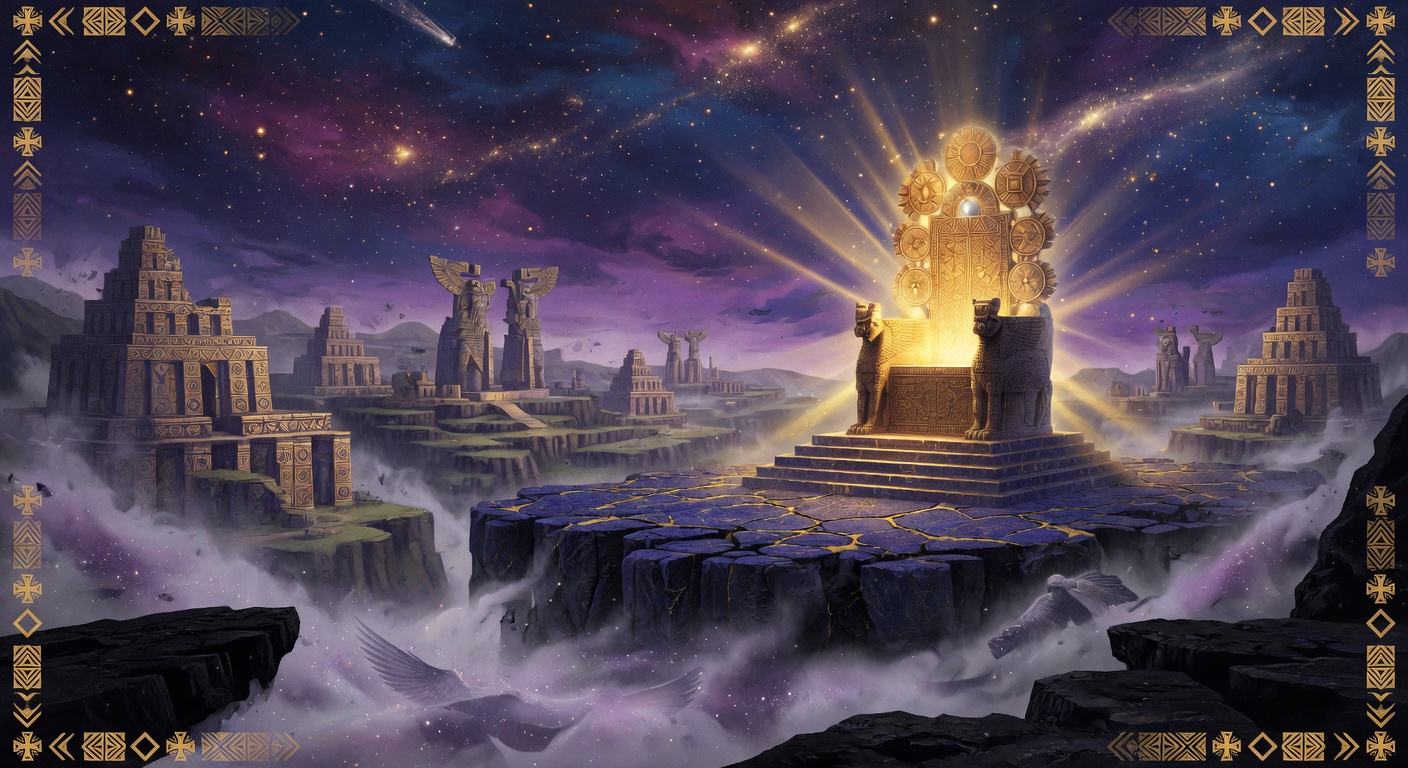
In the visionary accounts preserved within the Enochian corpus, the heavenly court emerges as the ultimate locus of divine authority, where cosmic order is maintained and eschatological judgment unfolds. Enoch's ascents reveal a structured celestial hierarchy in which a radiant throne serves as the focal point for the Lord of Spirits, surrounded by angelic hosts and the spirits of the righteous. This imagery underscores the texts' emphasis on transcendent sovereignty, distinguishing the eternal divine realm from the corruptible earth below and providing a framework for understanding the coming reversal of earthly injustice. Central to these descriptions is the association of the throne with the figure known as the Elect One or Son of Man, particularly in the Book of Parables. In 1 Enoch 62, the Lord of Spirits places this chosen figure upon the throne of glory to execute judgment over kings and the mighty, who tremble before his presence. Similarly, 1 Enoch 69:29 depicts the Son of Man seated there after the secrets of wisdom have been revealed, marking the consummation of divine rule. These passages draw on earlier throne visions such as those in 1 Enoch 14, yet they develop a distinctly messianic dimension, linking the throne's occupant to preexistent wisdom and future vindication of the faithful. Within the broader Enochian tradition, this celestial seat functions not merely as a static symbol of power but as the dynamic center from which righteousness is vindicated and the cosmos renewed. The throne's glory reflects the unapproachable holiness of the divine, while its accessibility to the visionary Enoch and the Son of Man highlights themes of mediation and revelation. Such motifs influenced later apocalyptic literature by offering a vivid portrayal of heavenly realities that affirm hope amid persecution, reminding readers that ultimate justice resides beyond the visible world.
Earth
-
Mount Hermon
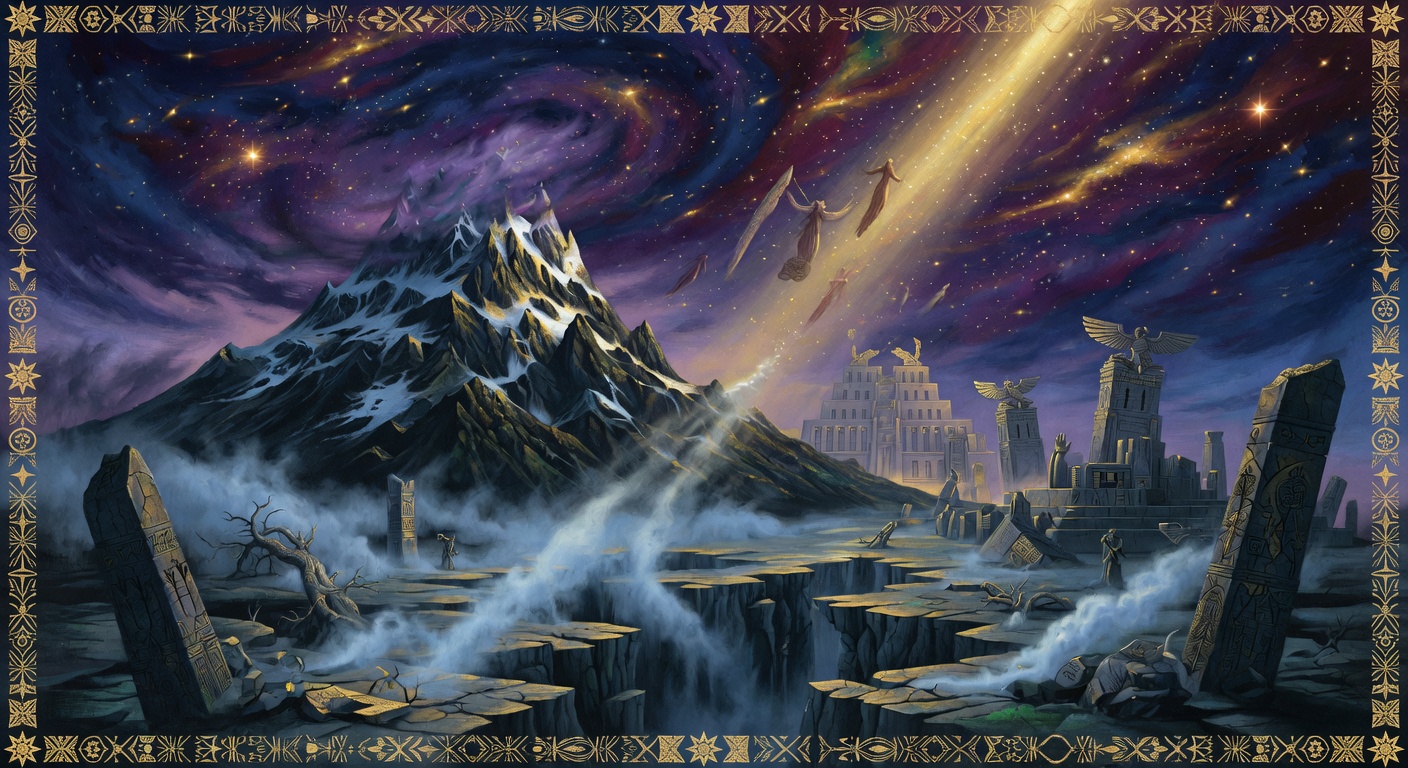
In the ancient traditions preserved within the Enochian corpus, a prominent peak in the northern regions serves as the pivotal site where celestial beings first breached the boundary between heaven and earth. This location marks the descent of the Watchers during the days of Jared, as recounted in the Book of Enoch, where two hundred angels under the leadership of Semjaza gathered to enact a fateful plan. Their arrival initiated a chain of events that would corrupt the natural order, introduce forbidden knowledge to humanity, and ultimately provoke divine judgment through the flood. The texts emphasize the solemn oath sworn upon this mountain, binding the Watchers to their shared purpose of taking human wives and producing offspring. In 1 Enoch 6:6, the narrative specifies that they descended upon its summit and named the place after the mutual imprecations they invoked, ensuring none would abandon the pact. This act of collective swearing underscores the gravity of their rebellion, transforming an otherwise ordinary elevation into a symbol of transgression. The Book of Jubilees echoes the timing of this descent in the days of Jared, framing it within a broader chronology of angelic rebellion and the subsequent spread of violence across the earth. Beyond its role in the initial fall, the mountain features in the unfolding consequences described across these apocryphal works, including the birth of the Nephilim and the dissemination of illicit arts such as metallurgy and sorcery. References in the Book of Jasher align with this tradition by alluding to the giants born from such unions, reinforcing the mountain's place as the origin point for earthly disorder. Within the Enochian tradition, it thus embodies both the allure of heavenly secrets and the irreversible rupture they caused, inviting later readers to reflect on the perils of crossing divine boundaries.
-
Mount Sinai
In the traditions of the Book of Jubilees, the lofty peak serves as the sacred locus where divine instruction bridges the primordial past with the covenantal future, allowing Moses to receive not only legal statutes but an expansive retelling of history from creation onward. Here the angel of the presence dictates the contents of the book itself, framing the mountain as both a physical height and a threshold between heavenly and earthly realms, where the rhythms of sacred time and the unfolding of human generations are disclosed in precise detail. This revelation occurs on the sixteenth day of the third month, aligning the event with the renewal of the covenant first established in the days of Noah, thereby underscoring the mountain’s role in reaffirming cosmic order amid Israel’s formation as a distinct people. Within the broader Enochian corpus, this site resonates with earlier visionary experiences recorded in 1 Enoch, particularly the Watchers’ descent and the subsequent judgment pronounced from heavenly thrones. Jubilees positions the Mosaic ascent as a continuation of Enoch’s own heavenly journeys, in which secrets of the luminaries, the calendar, and the destiny of the righteous are first unveiled. The mountain thus functions as a terrestrial counterpart to the celestial temple Enoch traverses, ensuring that the knowledge once granted to the seventh patriarch reaches the covenant community through Moses, who records it under angelic supervision as detailed in Jubilees chapters 1 and 2. The Book of Jasher further enriches this portrait by situating the mountain within narratives of patriarchal encounters and divine appearances that prefigure the later theophany, emphasizing continuity between the antediluvian sages and the lawgiver. Across these texts the peak emerges as more than a geographical marker; it embodies the transmission of hidden wisdom, the demarcation of sacred chronology, and the enduring link between the antediluvian revelations preserved by Enoch and the national constitution delivered at Sinai.
-
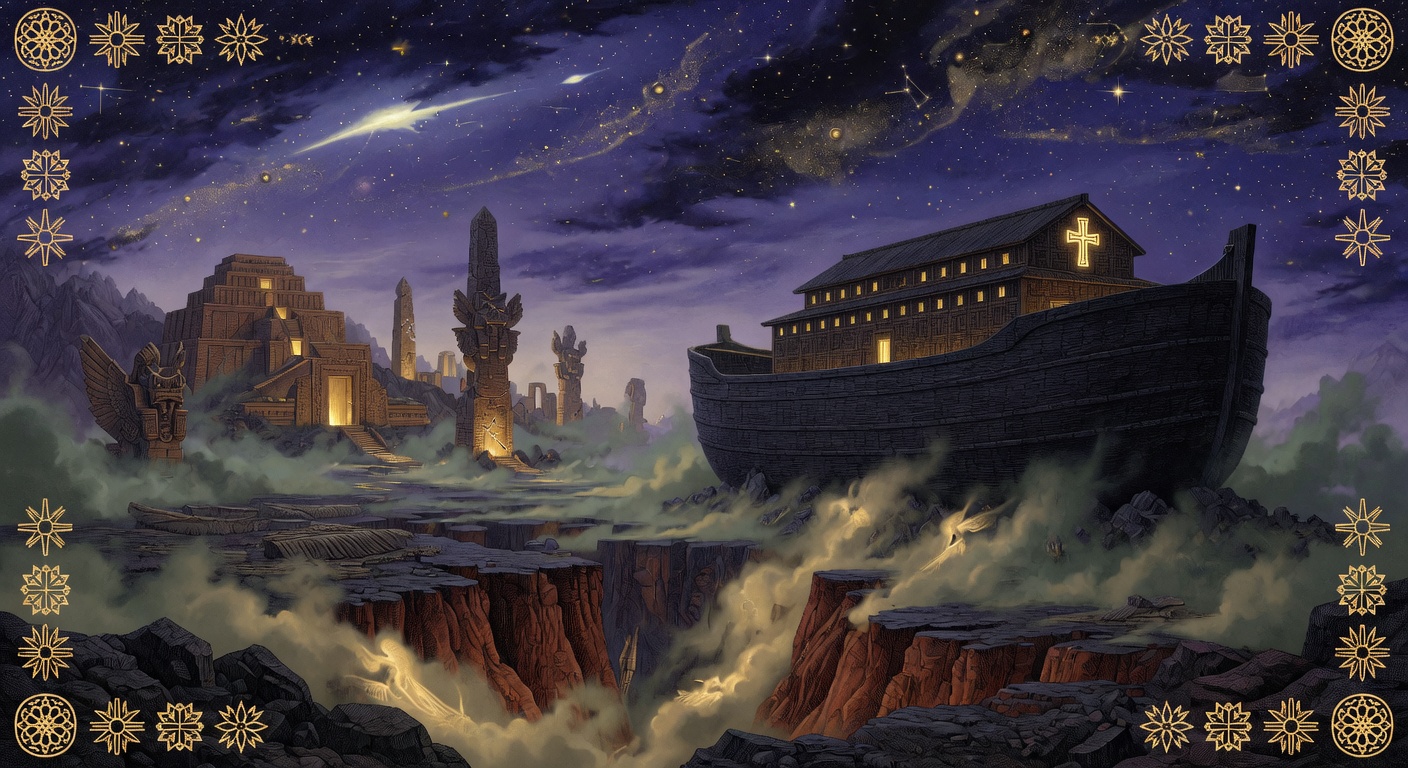
The Ark
In the Enochian and related apocryphal traditions, the vessel constructed by Noah emerges as a central symbol of divine preservation during the judgment that cleansed the earth of widespread corruption. The Books of Enoch and Jubilees frame this cataclysm not merely as punishment for human wickedness but as the necessary response to the transgressions of the Watchers, whose unions with human women produced the violent giants described in 1 Enoch 6–10. Noah, identified as the sole righteous man of his generation, receives explicit instructions for the vessel’s construction, ensuring the survival of his family and pairs of animals so that life might continue after the waters recede. The Book of Jubilees provides the most detailed account of the ark’s building and purpose, noting in chapter 5 that Noah completed the structure over five years according to angelic guidance, with precise dimensions that allowed it to withstand the flood’s force. This text emphasizes the ark’s role in separating the righteous remnant from the condemned world, culminating in the renewed covenant described in Jubilees 6. The Book of Jasher expands on the practical challenges of the construction, describing how Noah and his sons gathered materials and withstood mockery from their contemporaries while following the divine blueprint revealed through Enoch’s earlier revelations. Within the broader Enochian tradition, the vessel also carries eschatological weight. The Animal Apocalypse in 1 Enoch 89 portrays it symbolically as a secure enclosure that protects the chosen seed through the waters of judgment, prefiguring later themes of deliverance and covenant renewal. Far from a simple boat, it functions as a temporary sanctuary where the purity of creation is safeguarded until the earth can be restored under divine order.
-
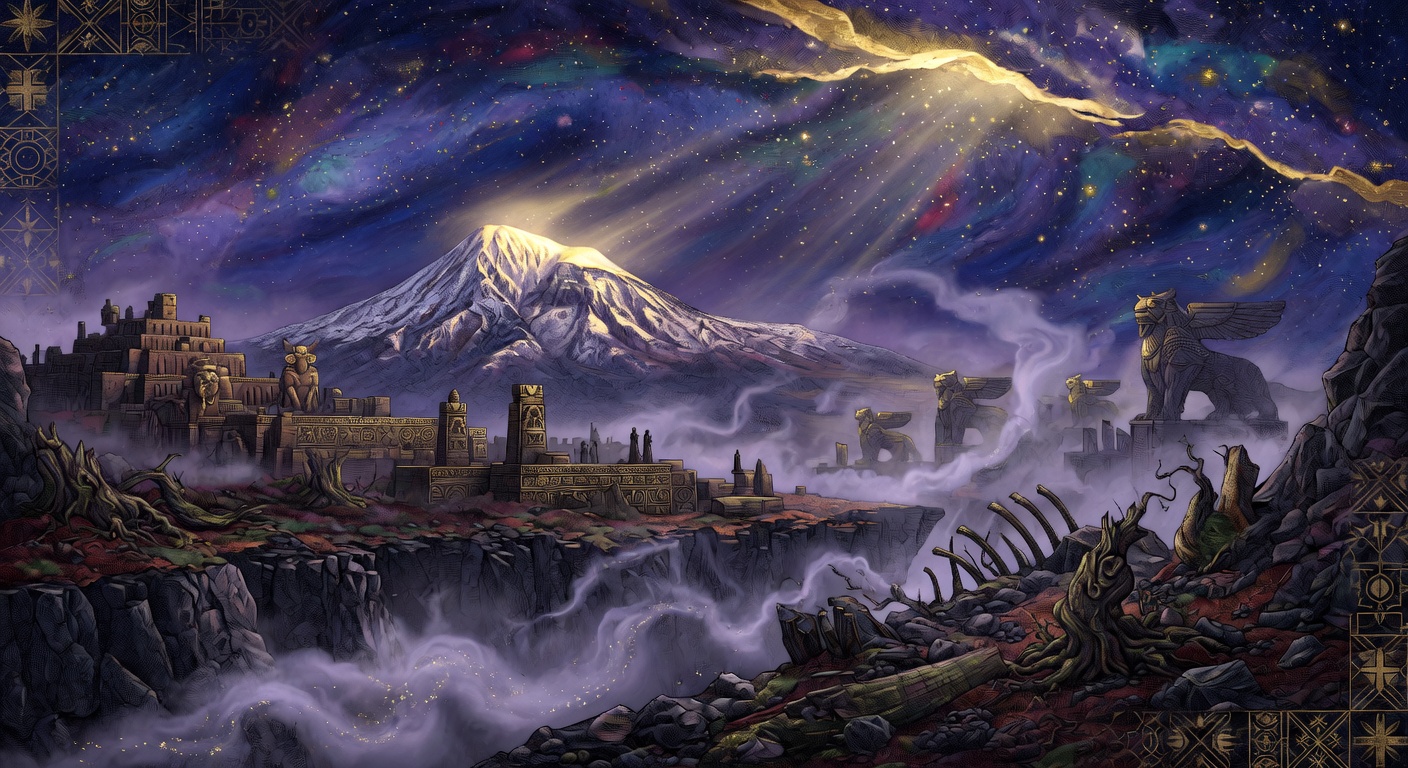
Mount Ararat
Following the cataclysmic judgment that purged the earth of widespread corruption, the texts preserved in these ancient traditions identify a specific highland region as the site where divine preservation gave way to renewal. In the Book of Jubilees, the ark settles upon Lubar, described explicitly as one of the mountains of Ararat, after one hundred and fifty days of prevailing waters. This detail appears in Jubilees 5:28, situating the event within a precise chronological framework that aligns the recession of the flood with the broader narrative of Noah’s obedience and the reestablishment of human society under renewed covenantal terms. The Book of Jasher complements this account by recording the ark’s arrival on the mountains of Ararat on the seventeenth day of the seventh month, underscoring the moment when the vessel ceases its wandering and becomes the cradle of post-diluvian life. While 1 Enoch does not name the mountain directly, its Animal Apocalypse in chapter 89 portrays the flood as the decisive intervention against the violence introduced by the Watchers, framing the ark’s deliverance of Noah as the pivot between eras of angelic transgression and human restoration. Together these references embed Ararat within an Enochic worldview that links cosmic judgment, angelic accountability, and the survival of righteous lineages. Scholars of these texts note that the mountain functions less as a mere geographical marker and more as a threshold symbolizing the transition from antediluvian chaos to ordered history. Jubilees further connects the site to subsequent patriarchal journeys, suggesting that the ark’s resting place served as an origin point for the dispersion of Noah’s descendants. Such details invite readers to consider how these apocryphal works expand the flood tradition into a sustained meditation on divine mercy and the reordering of creation.
-
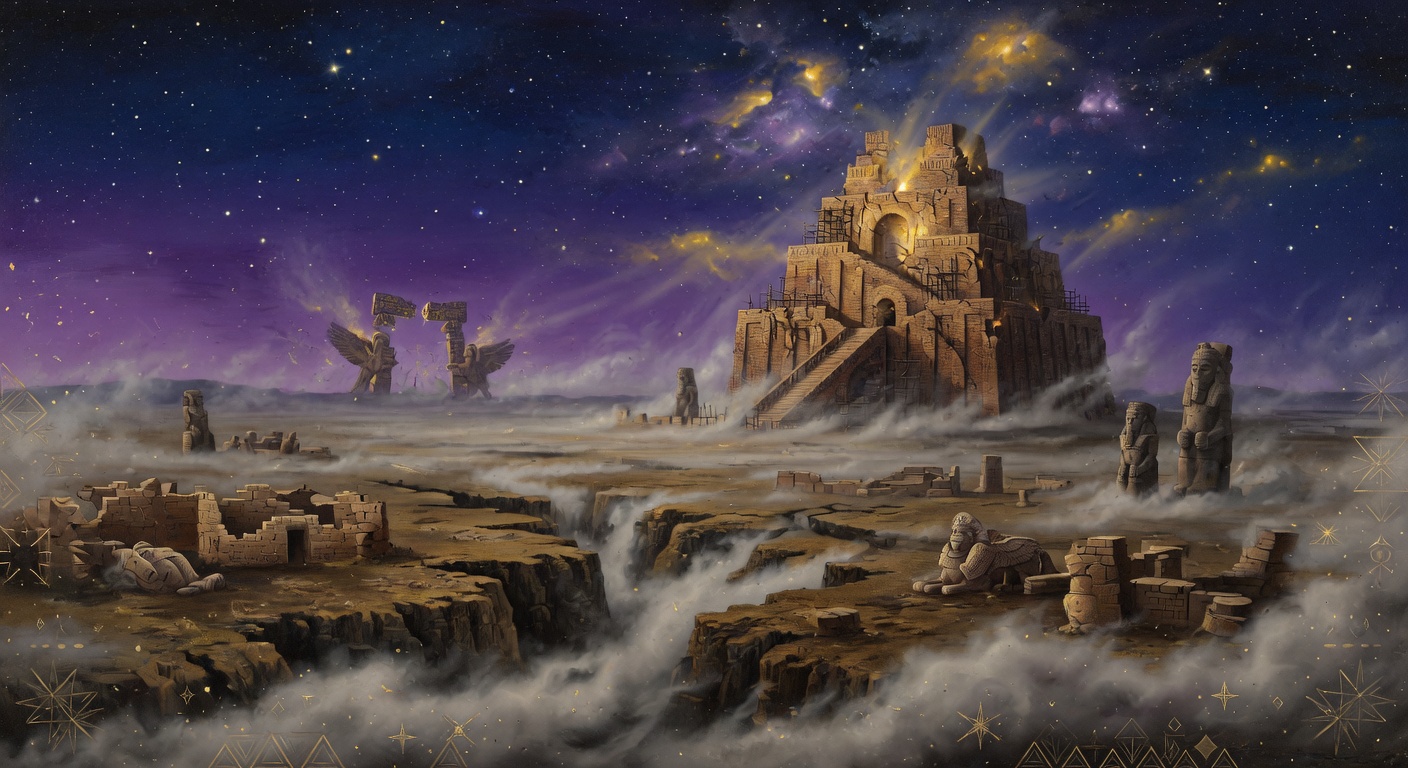
Babel / Shinar
In the generations following the great deluge, the land of Shinar emerges within these ancient writings as a pivotal arena where humanity sought to consolidate power and defy the divine order established after the flood. The Book of Jubilees recounts how the descendants of Noah, led by ambitious figures, migrated to this plain and resolved to construct a towering edifice that would serve as both a monument to their unity and a means to ascend toward the heavens. This endeavor, detailed in Jubilees 10:18-27, arises amid the redistribution of territories among Noah's sons, highlighting Shinar as a contested space where human ambition intersects with the lingering influences of pre-flood corruption. Central to this narrative stands Nimrod, portrayed across the texts as a mighty hunter and ruler whose dominion extends over these regions. The Book of Jasher expands on his role in chapters 7 through 9, describing how he rallied the people to erect the structure using baked bricks and bitumen, explicitly framing the project as an act of rebellion against the Most High to avoid another scattering or judgment. Within the Enochian tradition, such events resonate with the earlier accounts of the Watchers' transgression in 1 Enoch 6-16, where celestial beings imparted forbidden knowledge that fostered pride and technological overreach among humanity, suggesting a continuity of rebellious impulses from angelic descent to post-flood human enterprise. The significance of this locale extends beyond mere geography, embodying the tension between collective human striving and divine sovereignty. The confusion of languages that halts the construction, as elaborated in Jubilees, marks a pivotal moment of fragmentation, dispersing peoples and seeding the rise of distinct nations. This outcome parallels the binding of wayward spirits in Enoch's visions, underscoring themes of order restored through heavenly intervention and the limits imposed on unchecked expansion. Scholars examining these apocryphal works find in Shinar a symbolic nexus linking the flood's aftermath to the broader cosmic struggles depicted in Enoch, where earthly rebellions echo heavenly ones and set the stage for subsequent patriarchal histories.
-
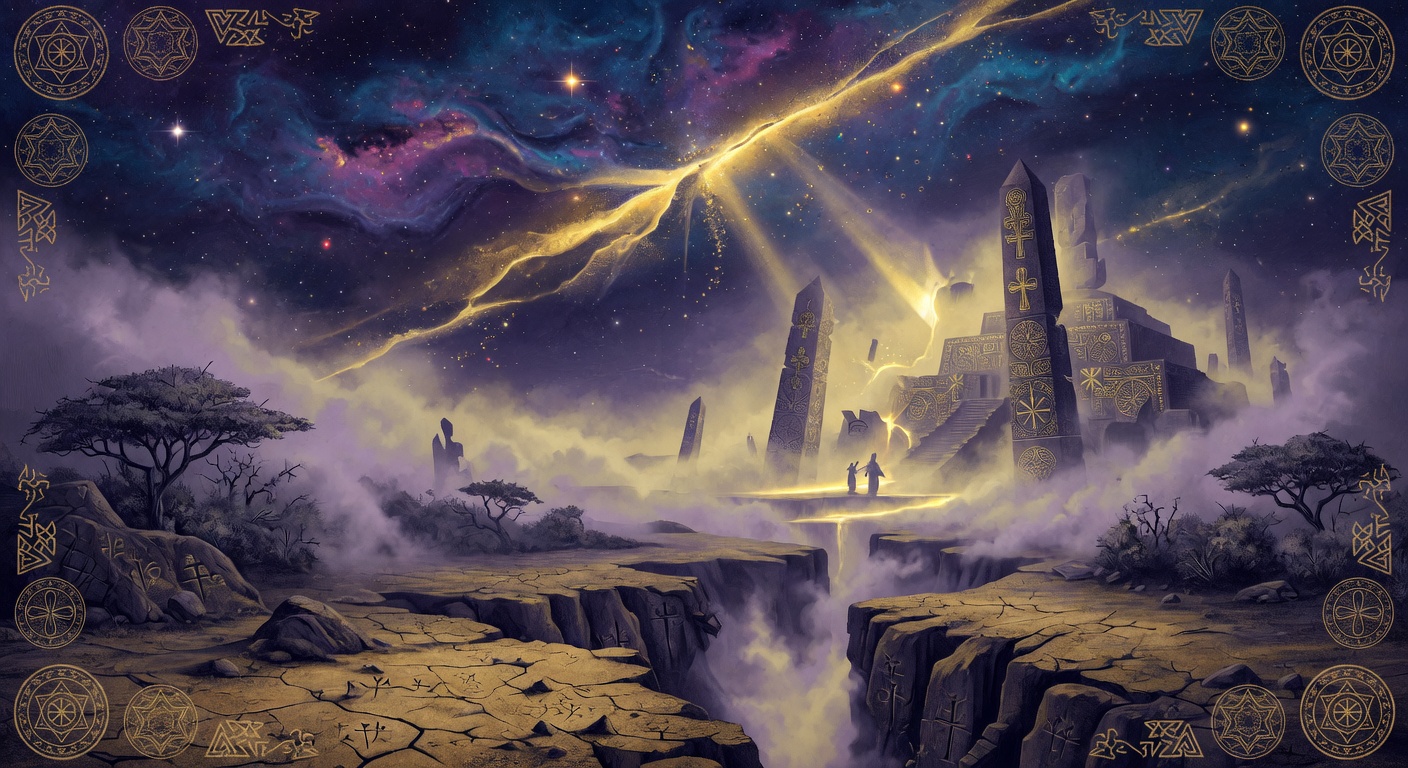
Canaan
In the aftermath of the great deluge, the pseudepigraphal traditions preserved in Jubilees portray the earth as carefully apportioned among the sons of Noah according to an oath sworn before the divine throne. Shem receives the central and most blessed portion, encompassing the territory that would later become the focus of the patriarchal covenants, while Ham and Japheth are allotted lands to the south and north respectively. Yet the narrative highlights a profound transgression when Canaan, the youngest son of Ham, defies this sacred division and settles instead within the boundaries assigned to Shem, an act that precipitates both a lasting curse and the future conflicts over possession of the land. This improper seizure receives further elaboration in Jubilees 10, where Canaan’s refusal to depart for his allotted inheritance near the sea prompts Noah to pronounce a malediction upon him and his descendants. The text emphasizes that the land in question, stretching from the river of Egypt to the Euphrates and including sites later associated with Salem and Hebron, was never intended for Ham’s line. Within the broader Enochic corpus, this territorial drama unfolds against the lingering shadow of the Watchers’ descent on Mount Hermon and the violence of the giants, suggesting that the region carried an inherent spiritual tension long before the patriarchs arrived. The Book of Jasher supplements these accounts with vivid patriarchal episodes, depicting Abraham, Isaac, and Jacob moving through Canaan’s cities and altars while contending with its indigenous inhabitants, who are traced genealogically to the cursed son of Ham. These stories underscore the land’s dual character as both the stage for covenantal promises and a realm still marked by the consequences of antediluvian rebellion. In the Enochian tradition, Canaan thus emerges not merely as a geographical prize but as a contested inheritance whose boundaries and moral status remain intertwined with the cosmic order established after the flood.
-
Egypt
In the intricate retellings of Israel's ancestral history preserved in Jubilees and Jasher, this realm functions as the decisive stage upon which divine promises to Abraham's descendants unfold through cycles of favor, exile, and eventual deliverance. Jubilees places particular emphasis on the precise chronology of events, recounting how Joseph arrives there after his brothers' betrayal and rises to prominence by interpreting Pharaoh's dreams, thereby securing grain stores that sustain the family during famine, as detailed in chapters 39 and 40. Jasher expands these episodes with additional narrative layers, highlighting Joseph's administrative wisdom and the gradual integration of Jacob's household into the land's social fabric. These accounts portray the realm not only as a site of personal elevation for Joseph but also as the setting for a profound reversal, where initial hospitality gives way to systematic oppression. Jubilees 46 describes how a new king arises who disregards Joseph's legacy, imposing harsh labor upon the growing Israelite population and prompting the secret preservation of Moses, thereby aligning earthly politics with the predetermined timelines that lead toward the Exodus. Such developments echo broader themes in the Enochian tradition of cosmic order disrupted by human rulers yet ultimately restored through heavenly intervention. Within this corpus, the land also embodies tensions between covenant fidelity and foreign influence, as the texts trace how patriarchal blessings persist despite cultural assimilation. References in Jubilees to the seventy weeks of years governing Israel's sojourn underscore a theological framework linking these events to Enoch's earlier revelations about divine judgment and renewal across generations. This perspective invites readers to view the realm as integral to understanding the transition from patriarchal wanderings to national formation under Mosaic law.
-

Ur of the Chaldees
In the patriarchal narratives preserved across the Book of Jubilees and the Book of Jasher, the ancient Mesopotamian city emerges as the cradle of Abraham's spiritual awakening amid widespread idolatry and astrological practices. These texts portray it not merely as a geographical location but as a realm steeped in the veneration of crafted images and celestial powers, where Terah and his household served as priests to multiple deities. This setting establishes the tension between emerging monotheistic insight and the dominant religious culture, framing Abraham's early life as a deliberate rejection of inherited traditions that trace back to the corrupted knowledge disseminated in earlier epochs. The Book of Jubilees details Abraham's birth and formative years in this environment, noting in chapters 11 and 12 how he observed the heavens and questioned the efficacy of idols fashioned by human hands. At age sixty, he sets fire to the temple of idols belonging to his father, an act that leads to the death of his brother Haran and precipitates the family's departure. The Book of Jasher expands this account with vivid episodes of Abraham's confrontations, including his public destruction of statues and subsequent trial by fire, underscoring the city's role as a site of both peril and revelation. These events highlight the place as a testing ground for faithfulness amid pressures that echo the antediluvian rebellions described in related Enochic literature. Within the broader Enochian tradition, this locale gains added resonance through its association with Chaldean expertise in astronomy and divination, forms of knowledge often viewed as extensions of the illicit teachings attributed to the Watchers in 1 Enoch. Abraham's discernment in these texts thus serves as a counterpoint to the cosmic disorders introduced by fallen angels, positioning his journey outward as a restoration of proper order and divine allegiance. Such portrayals invite readers to consider the city as a symbolic threshold between eras of spiritual decline and renewal.