Fall of Jericho
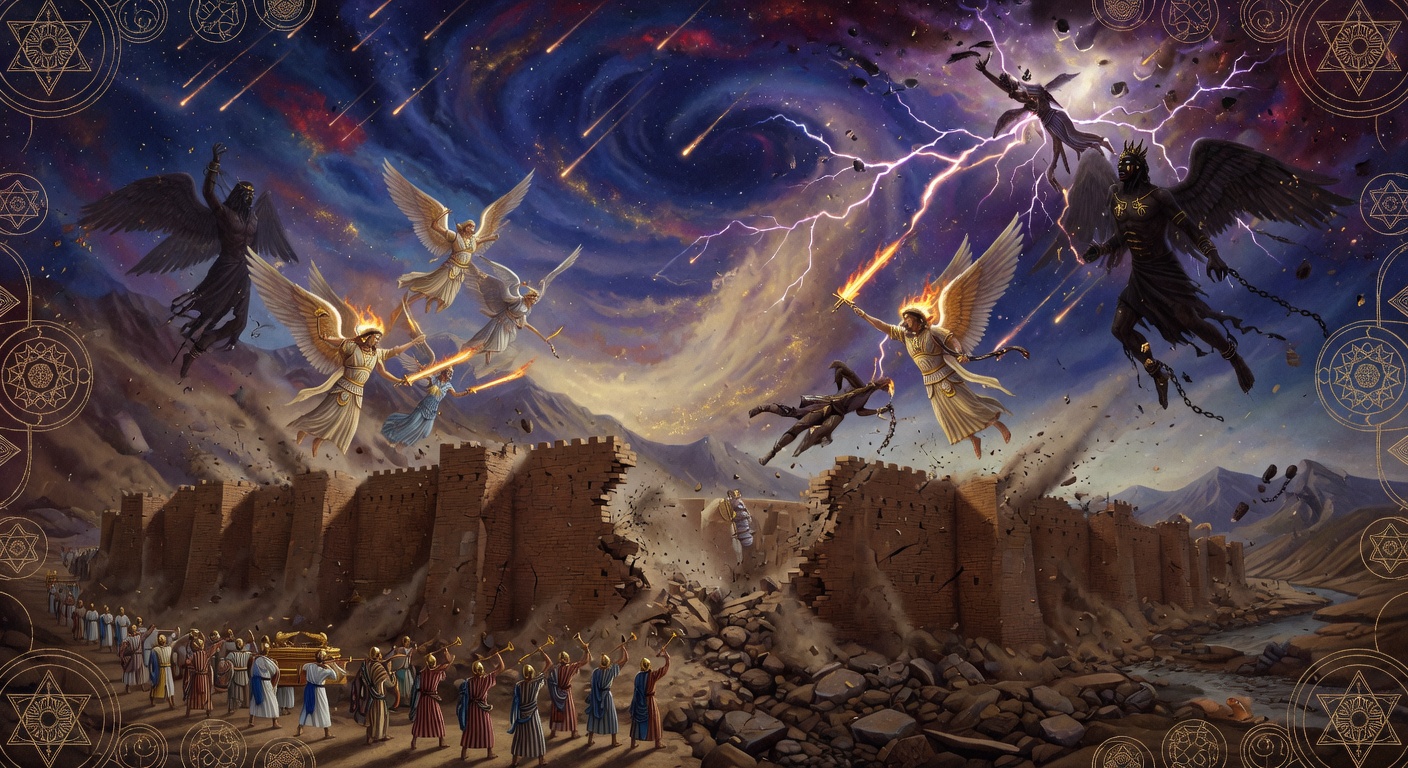
The conquest narratives preserved in ancient Hebrew traditions underscore the recurring motif of divine orchestration in the face of seemingly insurmountable human fortifications, where obedience to prescribed rituals precipitates supernatural outcomes. Within the expansions found in the Book of Jasher, this episode unfolds through seven successive circuits around the city, with priests sounding trumpets each day and the people maintaining silence until the final circuit on the seventh day, at which point a unified shout causes the walls to collapse inward. This account in Jasher 88 aligns closely with the core sequence while elaborating on the preparatory commands given to Joshua, emphasizing the precise alignment of human action with instructions attributed to the divine realm. Such events resonate with broader patterns in the Enochian corpus, particularly the interplay between angelic mediation and earthly judgment seen throughout 1 Enoch. The use of trumpets and a collective shout evokes the apocalyptic imagery of heavenly watchers executing decrees, as in the visions of cosmic upheaval and the sounding of signals that precede the downfall of rebellious powers. Although the Book of Enoch itself focuses on primordial transgressions rather than later conquests, the thematic continuity highlights how later pseudepigraphal works like Jasher extend these ideas of ordered divine timing into historical episodes, portraying the fall not as military strategy but as fulfillment of a predetermined cosmic sequence. The Book of Jubilees, with its calendrical emphasis on sevens and sabbatical structures drawn from Enochic traditions, further contextualizes the seven-day framework as an extension of sacred timekeeping that governs pivotal transitions in Israel's story. This ritual observance transforms the siege into an act of liturgical procession, reinforcing the idea that territorial claims rest upon alignment with heavenly patterns rather than force alone. Readers encountering these texts thus gain insight into a worldview where physical barriers yield to the synchronized proclamation of divine will, illustrating continuity between antediluvian revelations and the establishment of the covenant people in their allotted inheritance.
Details
- Era
- Exodus & Conquest
- Category
- Conquest
- Participants
- Israel (Joshua) vs. Jericho
- Outcome
- City walls collapse, city devoted
- Divine Intervention
- Yes
Key Chapters
Key Passages
The Conquest
The Book of Jasher 88:1-20
 1nd all the people of Sodom and Gomorrah went there four times in the year, with their wives and children and all belonging to them, and they rejoiced there with timbrels and dances.
Did You Know?
The walls fell after silent marching and a final shout - no conventional siege weapons.