Feast of Weeks (Shavuot)
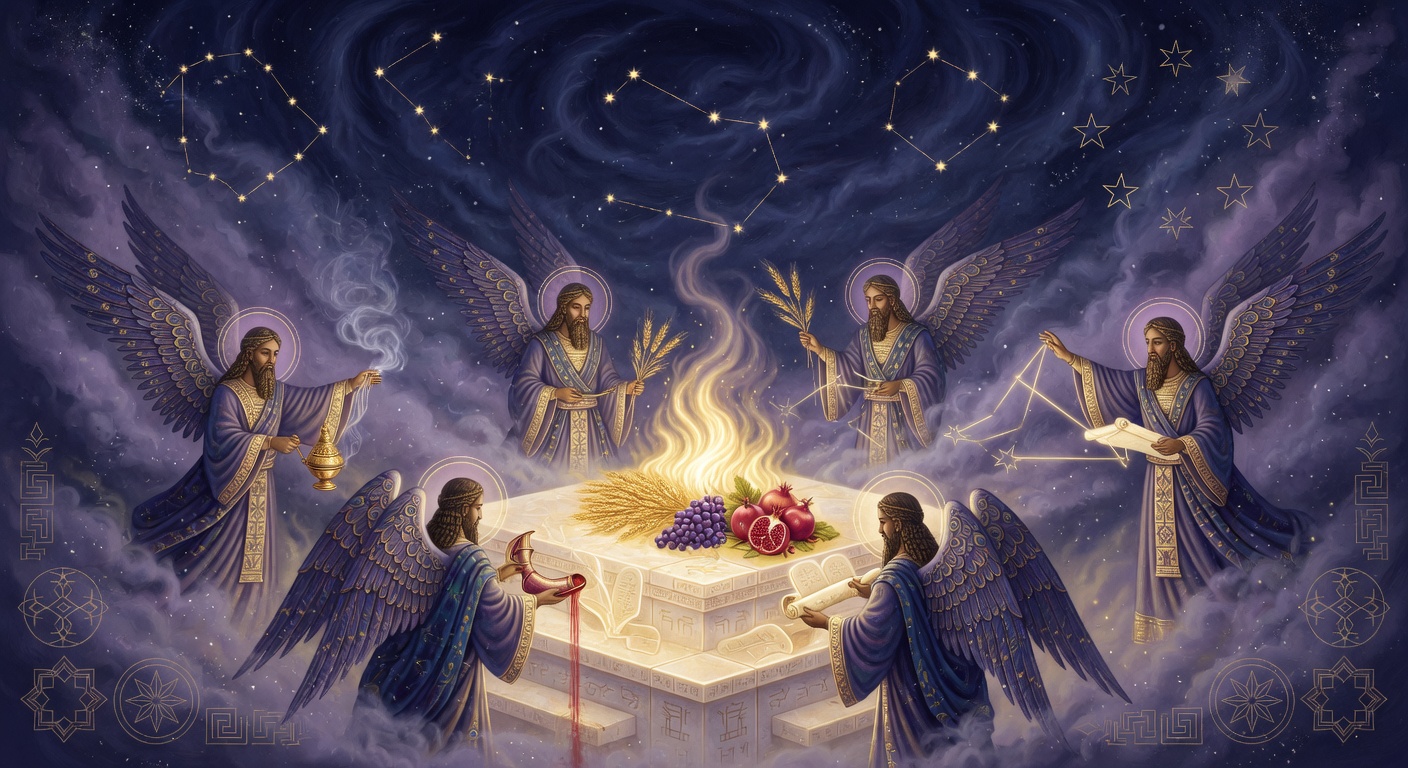
Among the sacred observances preserved in the ancient pseudepigraphal writings, one stands out for its profound connection to covenantal renewal and the rhythms of creation. The Book of Jubilees presents this festival as the foremost of all appointed times, tracing its origins not merely to Sinai but to the very structure of heaven itself. In chapter 6, the text recounts how Noah, after the flood, establishes the observance on the first day of the third month, binding his descendants through an eternal oath that echoes the covenant made with creation. This emphasis elevates the feast beyond agricultural gratitude, framing it instead as a perpetual renewal of the divine order disrupted by human transgression. The patriarchal narratives in Jubilees further illustrate its centrality, with figures such as Abraham, Isaac, and Jacob each marking key moments of covenant through its celebration. Abraham’s renewal in chapter 15, for instance, aligns the rite with promises of land and progeny, while similar observances by his descendants underscore a continuous chain of fidelity. The text insists that the festival was already kept in heaven by the angels from the time of creation, positioning earthly practice as an imitation of celestial order rather than a later innovation. This heavenly precedent distinguishes the account from other Second Temple sources and integrates it with the solar calendar detailed across Jubilees and the Enochic astronomical book. Within the broader Enochian tradition, the feast gains additional layers through its alignment with themes of revelation and cosmic regularity. The Astronomical Book of 1 Enoch supplies the calendrical framework that ensures the observance falls consistently, free from lunar drift, thereby safeguarding its timing for covenantal commemoration. Although the Book of Jasher offers fewer explicit details, it echoes the patriarchal emphasis on seasonal rites tied to divine encounters. Together these texts portray the festival as both a memorial of law-giving and an affirmation of first fruits offered in harmony with the created order, inviting later readers to see their own fidelity as part of an unbroken heavenly pattern.
Details
- Category
- Early Summer
- Timing
- 50 days after First Fruits (6th of Sivan)
- Season
- Summer
Key Chapters
Key Passages
Feast of Weeks at Sinai
The Book of Jubilees 6:1-38
 1nd on the new moon of the third month he went forth from the ark, and built an altar on that mountain. And he made atonement for the earth, and took a kid and made atonement by its blood for all the guilt of the earth; for everything that had been on it had been destroyed, save those that were in the ark with Noah. And he placed the fat thereof on the altar, and he took an ox, and a goat, and a sheep and kids, and salt, and a turtle-dove, and the young of a dove, and placed a burnt sacrifice on the altar, and poured thereon an offering mingled with oil, and sprinkled wine and strewed frankincense over everything, and caused a goodly savour to arise, acceptable before the Lord. And the Lord smelt the goodly savour, and He made a covenant with him that there should not be any more a flood to destroy the earth; that all the days of the earth seed-time and harvest should never cease; cold and heat, and summer and winter, and day and night should not change their order, nor cease for ever. 'And you, increase ye and multiply upon the earth, and become many upon it, and be a blessing upon it. The fear of you and the dread of you I will inspire in everything that is on earth and in the sea. And behold I have given unto you all beasts, and all winged things, and everything that moves on the earth, and the fish in the waters, and all things for food; as the green herbs, I have given you all things to eat. But flesh, with the life thereof, with the blood, ye shall not eat; for the life of all flesh is in the blood, lest your blood of your lives be required. At the hand of every man, at the hand of every (beast) will I require the blood of man. Whoso sheddeth man's blood by man shall his blood be shed, for in the image of 9,10 God made He man. And you, increase ye, and multiply on the earth.' And Noah and his sons swore that they would not eat any blood that was in any flesh, and he made a covenant before the
Renewed by Noah and Abraham
The Book of Jubilees 15:1-3
1nd in the fifth year of the fourth week of this jubilee, in the third month, in the middle of the month, Abram celebrated the feast of the first-fruits of the grain harvest. And he offered new offerings on the altar, the first-fruits of the produce, unto the Lord, an heifer and a goat and a sheep on the altar as a burnt sacrifice unto the Lord; their fruit offerings and their drink offerings he offered upon the altar with frankincense. And the Lord appeared to Abram, and said unto him:
Jacob celebrates at Bethel
The Book of Jubilees 44:1-4
1nd Israel took his journey from Haran from his house on the new moon of the third month, and he went on the way of the Well of the Oath, and he offered a sacrifice to the God of his father Isaac on the seventh of this month. And Jacob remembered the dream that he had seen at Bethel, and he feared to go down into Egypt. And while he was thinking of sending word to Joseph to come to him, and that he would not go down, he remained there seven days, if perchance he could see a vision as to whether he should remain or go down. And he celebrated the harvest festival of the first-fruits with old grain, for in all the land of Canaan there was not a handful of seed , for the famine was over all the beasts and cattle and birds, and also over man. And on the sixteenth the Lord appeared unto him, and said unto him, 'Jacob, Jacob'; and he said, 'Here am I.' And He said unto him: 'I am the God of thy fathers, the God of Abraham and Isaac; fear not to go down into Egypt, for I will there make of thee a great nation I will go down with thee, and I will bring thee up (again), and in this land shalt thou be buried, and Joseph shall put his hands upon thy eyes. Fear not; go down into Egypt.'
Did You Know?
Jubilees calls it the 'feast of oaths' and the most important annual feast.
It was observed in heaven from creation and by all the righteous patriarchs.
Jubilees traces it all the way back to Noah's covenant after the flood — not just Sinai.
It is called the 'feast of oaths' because every major covenant was renewed on this day.
Angels in heaven have observed it since creation, making earthly celebration a mirror of celestial worship.