Covenant and Eternal Law
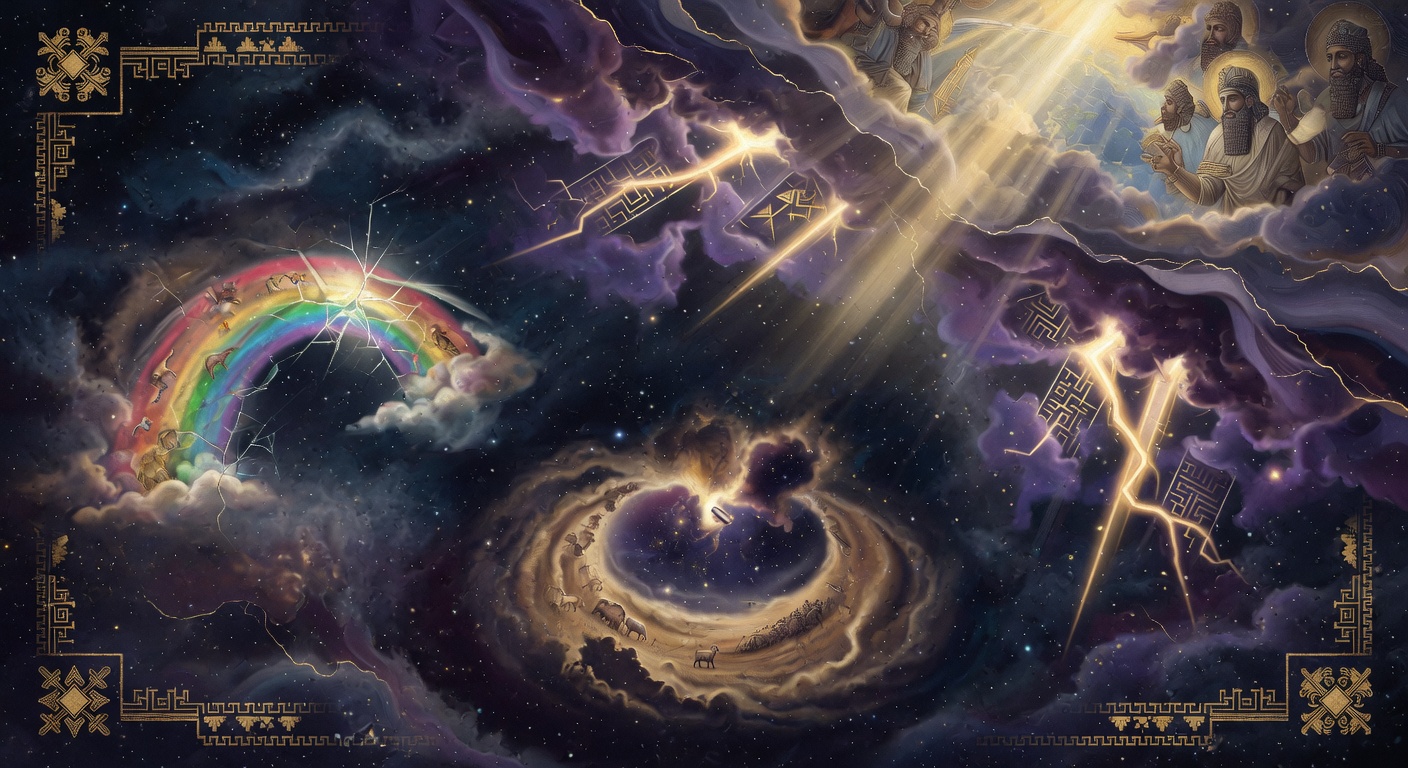
In the ancient pseudepigraphal traditions, divine covenants function not merely as historical agreements but as expressions of an eternal order established at creation itself. These texts portray God's dealings with humanity as renewals of a primordial law that governs time, ethics, and cosmic stability, rather than innovations introduced at later moments of crisis. The narrative arc moves from the antediluvian period through the patriarchs to Sinai, presenting each covenant as a reaffirmation of statutes already inscribed in the heavenly tablets and operative since the first week of the world. The Book of Jubilees develops this theme with particular clarity by insisting that the calendar, festivals, and moral commandments predate the Flood. Noah receives the covenant of the rainbow in chapter 6 together with explicit instructions on the solar reckoning of 364 days, while Abraham's covenant in chapter 15 renews the same laws of circumcision and separation that had been observed by Enoch and Noah. Jubilees thereby frames the later revelation at Sinai as a restoration rather than an origin, emphasizing that Israel's fidelity to these written ordinances maintains the created order against the chaos introduced by the Watchers. First Enoch complements this perspective through its depiction of the heavenly tablets and the eternal laws entrusted to the patriarch, who records judgments that will stand until the final renewal of heaven and earth. Although Enoch does not narrate patriarchal covenants in detail, its portrayal of fixed celestial cycles and immutable decrees supplies the cosmological foundation that Jubilees later applies to Israel's legal tradition. The Book of Jasher, in turn, preserves narrative expansions of the patriarchal stories that underscore the continuity of these obligations across generations. Taken together, these writings present covenant and law as twin aspects of a single divine economy, one that begins before history and extends beyond it. Readers encounter a worldview in which Sinai completes what was already latent in creation, binding Israel to an order that angels and patriarchs alike were summoned to keep.
Details
- Category
- Covenantal
Key Chapters
Key Passages
Noahic and Abrahamic
The Book of Jubilees 6:1-17
 1nd on the new moon of the third month he went forth from the ark, and built an altar on that mountain. And he made atonement for the earth, and took a kid and made atonement by its blood for all the guilt of the earth; for everything that had been on it had been destroyed, save those that were in the ark with Noah. And he placed the fat thereof on the altar, and he took an ox, and a goat, and a sheep and kids, and salt, and a turtle-dove, and the young of a dove, and placed a burnt sacrifice on the altar, and poured thereon an offering mingled with oil, and sprinkled wine and strewed frankincense over everything, and caused a goodly savour to arise, acceptable before the Lord. And the Lord smelt the goodly savour, and He made a covenant with him that there should not be any more a flood to destroy the earth; that all the days of the earth seed-time and harvest should never cease; cold and heat, and summer and winter, and day and night should not change their order, nor cease for ever. 'And you, increase ye and multiply upon the earth, and become many upon it, and be a blessing upon it. The fear of you and the dread of you I will inspire in everything that is on earth and in the sea. And behold I have given unto you all beasts, and all winged things, and everything that moves on the earth, and the fish in the waters, and all things for food; as the green herbs, I have given you all things to eat. But flesh, with the life thereof, with the blood, ye shall not eat; for the life of all flesh is in the blood, lest your blood of your lives be required. At the hand of every man, at the hand of every (beast) will I require the blood of man. Whoso sheddeth man's blood by man shall his blood be shed, for in the image of 9,10 God made He man. And you, increase ye, and multiply on the earth.' And Noah and his sons swore that they would not eat any blood that was in any flesh, and he made a covenant before the
Did You Know?
Jubilees presents covenants as eternal and already known before Sinai.
The calendar and feasts are part of the 'eternal' law.