Abraham

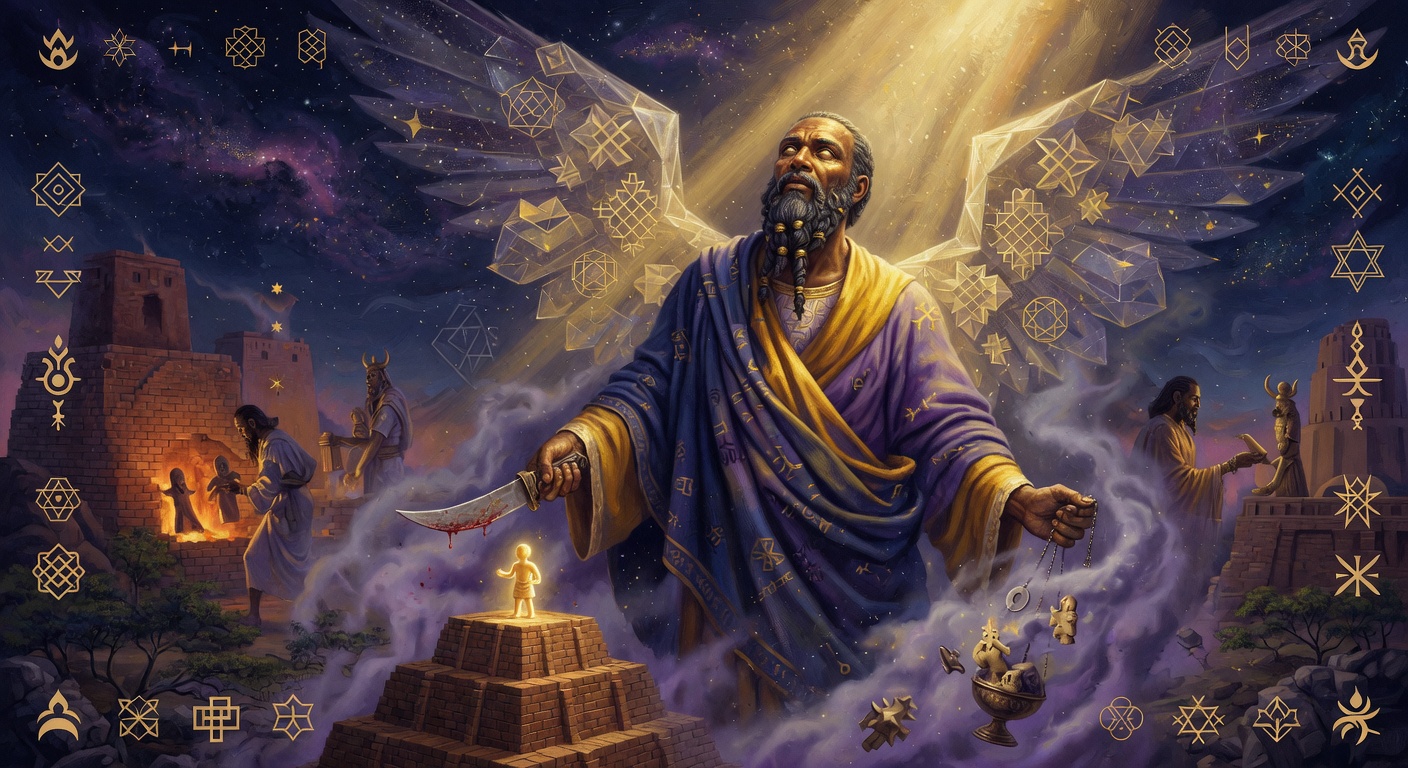
Portrait of Abraham

Among the patriarchs venerated in the corpus of Second Temple Jewish writings that includes the Enochic books, Abraham stands as the preeminent model of covenantal fidelity and the rejection of idolatry. These texts, particularly the Book of Jubilees and the Book of Jasher, expand the terse Genesis narrative into extended accounts that situate him within a cosmic struggle between divine order and the forces of deception, echoing the angelic rebellions and calendrical revelations found in 1 Enoch. His story serves as a bridge between the antediluvian wisdom preserved by Enoch and the establishment of Israel’s distinct identity under the law. In Jubilees, Abraham emerges as the first to actively dismantle the idolatrous culture of his ancestors. Chapters 11 and 12 recount how, as a youth in Ur, he separates from his father Terah’s household, burns the temple of idols, and receives the covenant promises directly from the Most High, including instructions on circumcision and the proper observance of festivals. The Akedah narrative in chapters 17–18 heightens the drama by framing the near-sacrifice of Isaac as a test orchestrated to counter Mastema’s accusations, underscoring Abraham’s perfect obedience. Before his death, he delivers detailed ethical and ritual teachings to his sons Isaac and Jacob in chapter 20, emphasizing separation from Canaanite practices and fidelity to the heavenly tablets. The Book of Jasher supplies additional legendary texture, especially in its accounts of Abraham’s early conflicts with the tyrant Nimrod and his trials in the fiery furnace. These episodes portray him as a figure of miraculous deliverance and intellectual resistance, whose astronomical and moral insights challenge the astrological systems of Chaldea. Within the broader Enochic tradition, Abraham’s role highlights the transmission of revealed knowledge across generations, linking Enoch’s heavenly journeys and warnings against the Watchers to the patriarchal covenants that shape Israel’s future.

0:00

Biography

Occupation
Patriarch and Friend of God
Father
Terah
Era
Patriarchal

Family

Parents
Abraham
Patriarch Jubilees Jasher

Did You Know?

1

Abraham is called the "Friend of God" in the ancient writings.

2

He destroyed his father Terah's idols and was delivered from Nimrod's furnace.

Key Chapters

Key Passages

Abram Burns the Idols

The Book of Jubilees 12:1-14

As a youth, Abram realizes the futility of idols, burns his father Terah's shop, and is brought before Nimrod; God delivers him from the fiery furnace.
A1nd it came to pass in the sixth week, in the seventh year thereof, that Abram said to Terah his father, saying, 'Father!' And he said, 'Behold, here am I, my son.' And he said, 'What help and profit have we from those idols which thou dost worship, And before which thou dost bow thyself

2 For there is no spirit in them, For they are dumb forms, and a misleading of the heart. Worship them not: 3 Worship the God of heaven, Who causes the rain and the dew to descend on the earth And does everything upon the earth, And has created everything by His word, And all life is from before His face. 4 Why do ye worship things that have no spirit in them For they are the work of (men's) hands, And on your shoulders do ye bear them, And ye have no help from them, But they are a great cause of shame to those who make them, And a misleading of the heart to those who worship them: Worship them not.' 5 And his father said unto him, I also know it, my son, but what shall I do with a people who have made me to serve before them And if I tell them the truth, they will slay me; for their soul cleaves to them to worship them and honour them. Keep silent, my son, lest they slay thee.' And these words he spake to his two brothers, and they were angry with him and he kept silent. And in the fortieth jubilee, in the second week, in the seventh year thereof, Abram took to himself a wife, and her name was Sarai, the daughter of his father, and she became his wife. And Haran, his brother, took to himself a wife in the third year of the third week, and she bare him a son in the seventh year of this week, and he called his name Lot. And Nahor, his brother, took to himself a wife. And in the sixtieth year of the life of Abram, that is, in the fourth week, in the fourth year thereof, Abram arose by night, and burned the house of the idols, and he burned all that was in the house and no man knew it. And they arose in the night and sought to save their gods from the midst of the fire. And Haran hasted to save them, but the fire flamed over him, and he was burnt in the fire, and he died in Ur of the Chaldees before Terah his father, and they buried him in Ur of the Chaldees. And Terah went forth from Ur of the Chaldees, he and his sons, to go into the land of Lebanon and into the land of Canaan, and he dwelt in the land of Haran, and Abram dwelt with 6 Terah his father in Haran two weeks of years. And in the sixth week, in the fifth year thereof, Abram sat up throughout the night on the new moon of the seventh month to observe the stars from the evening to the morning, in order to see what would be the character of the year with regard to the rains, and he was alone as he sat and observed. And a word came into his heart and he said: All the signs of the stars, and the signs of the moon and of the sun are all in the hand of the Lord. Why do I search (them) out 7 If He desires, He causes it to rain, morning and evening; And if He desires, He withholds it, And all things are in his hand.' 8 And he prayed that night and said, 'My God, God Most High, Thou alone art my God, And Thee and Thy dominion have I chosen. And Thou hast created all things, And all things that are the work of thy hands. 9 Deliver me from the hands of evil spirits who have dominion over the thoughts of men's hearts, And let them not lead me astray from Thee, my God. And stablish Thou me and my seed for ever That we go not astray from henceforth and for evermore.' 10 And he said, 'Shall I return unto Ur of the Chaldees who seek my face that I may return to them, am I to remain here in this place The right path before Thee prosper it in the hands of Thy servant that he may fulfil (it) and that I may not walk in the deceitfulness of my heart, O my God.' 11 And he made an end of speaking and praying, and behold the word of the Lord was sent to him through me, saying: 'Get thee up from thy country, and from thy kindred and from the house of thy father unto a land which I will show thee, and I shall make thee a great and numerous nation. 12 And I will bless thee And I will make thy name great, And thou shalt be blessed in the earth, And in Thee shall all families of the earth be blessed, And I will bless them that bless thee, And curse them that curse thee. 13 And I will be a God to thee and thy son, and to thy son's son, and to all thy seed: fear not, from henceforth and unto all generations of the earth I am thy God.' And the Lord God said: 'Open his mouth and his ears, that he may hear and speak with his mouth, with the language which has been revealed'; for it had ceased from the mouths of all the children of men from the day of the overthrow (of Babel). And I opened his mouth, and his ears and his lips, and I began to speak with him in Hebrew in the tongue of the creation. And he took the books of his fathers, and these were written in Hebrew, and he transcribed them, and he began from henceforth to study them, and I made known to him that which he could not (understand), and he studied them during the six rainy months. And it came to pass in the seventh year of the sixth week that he spoke to his father and informed him, that he would leave Haran to go into the land of Canaan to see it and return to him. And Terah his father said unto him; Go in peace: May the eternal God make thy path straight. And the Lord protect thee from all evil, And grant unto thee grace, mercy and favour before those who see thee, And may none of the children of men have power over thee to harm thee; Go in peace. 14 And if thou seest a land pleasant to thy eyes to dwell in, then arise and take me to thee and take

Read full chapter: The Book of Jubilees 12 →

The Sacrifice of Isaac

The Book of Jubilees 18:1-19

God tests Abraham by commanding him to offer Isaac on Mount Moriah; Abraham's perfect obedience and Isaac's willingness are counted as righteousness; the ram is provided.

o1n one of the mountains which I will point out unto thee.' And he rose early in the morning and saddled his ass, and took his two young men with him, and Isaac his son, and clave the wood of the burnt offering, and he went to the place on the third day, and he saw the place afar off. And he came to a well of water, and he said to his young men, 'Abide ye here with the ass, and I and the lad shall go (yonder), and when we have worshipped we shall come again to you.' And he took the wood of the burnt-offering and laid it on Isaac his son, and he took in his hand the fire and the knife, and they went both of them together to that place. And Isaac said to his father, 'Father;' and he said, 'Here am I, my son.' And he said unto him, 'Behold the fire, and the knife, and the wood; but where is the sheep for the burnt-offering, father' And he said, 'God will provide for himself a sheep for a burnt-offering, my son.' And he drew near to the place of the mount of

2 God. And he built an altar, and he placed the wood on the altar, and bound Isaac his son, and placed him on the wood which was upon the altar, and stretched forth his hand to take the knife to slay Isaac his son. And I stood before him, and before the prince Mastema, and the Lord said, 'Bid him not to lay his hand on the lad, nor to do anything to him, for I have shown that he fears the Lord.' And I called to him from heaven, and said unto him: 'Abraham, Abraham;' and he was terrified and said: 'Behold, (here) am I.' And I said unto him: 'Lay not thy hand upon the lad, neither do thou anything to him; for now I have shown that thou fearest the Lord, and hast not withheld thy son, thy first-born son, from me.' And the prince Mastema was put to shame; and Abraham lifted up his eyes and looked, and, behold a ram caught . . . by his horns, and Abraham went and took the ram and offered it for a burnt-offering in the stead of his son. And Abraham called that place 'The Lord hath seen', so that it is said the Lord hath seen: that is 3 Mount Sion. And the Lord called Abraham by his name a second time from heaven, as he caused us to appear to speak to him in the name of the Lord. And he said: 'By Myself have I sworn, saith the Lord, Because thou hast done this thing, And hast not withheld thy son, thy beloved son, from Me, That in blessing I will bless thee, And in multiplying I will multiply thy seed As the stars of heaven, And as the sand which is on the seashore. And thy seed shall inherit the cities of its enemies, 4 And in thy seed shall all nations of the earth be blessed; Because thou hast obeyed My voice, And I have shown to all that thou art faithful unto Me in all that I have said unto thee: Go in peace.' 5 And Abraham went to his young men, and they arose and went together to Beersheba, and Abraham dwelt by the Well of the Oath. And he celebrated this festival every year, seven days with joy, and he called it the festival of the Lord according to the seven days during which he went and returned in peace. And accordingly has it been ordained and written on the heavenly tablets regarding Israel and its seed that they should observe this festival seven days with the joy of festival.

Read full chapter: The Book of Jubilees 18 →

Abraham and Nimrod in Jasher

The Book of Jasher 8:1-40

Detailed account of Abram's early life under Nimrod, his discovery of the true God, destruction of idols, and miraculous deliverance from the furnace of the Chaldees.

A1nd when the sons of men caused some of their wives to drink, Zillah drank with them.

2 And the child-bearing women appeared abominable in the sight of their husbands as widows, whilst their husbands lived, for to the barren ones only they were attached. 3 And in the end of days and years, when Zillah became old, the Lord opened her womb. 4 And she conceived and bare a son and she called his name Tubal Cain, saying, After I had withered away have I obtained him from the Almighty God. 5 And she conceived again and bare a daughter, and she called her name Naamah, for she said, After I had withered away have I obtained pleasure and delight. 6 And Lamech was old and advanced in years, and his eyes were dim that he could not see, and Tubal Cain, his son, was leading him and it was one day that Lamech went into the field and Tubal Cain his son was with him, and whilst they were walking in the field, Cain the son of Adam advanced towards them; for Lamech was very old and could not see much, and Tubal Cain his son was very young. 7 And Tubal Cain told his father to draw his bow, and with the arrows he smote Cain, who was yet far off, and he slew him, for he appeared to them to be an animal. 8 And the arrows entered Cain's body although he was distant from them, and he fell to the ground and died. 9 And the Lord requited Cain's evil according to his wickedness, which he had done to his brother Abel, according to the word of the Lord which he had spoken. 10 And it came to pass when Cain had died, that Lamech and Tubal went to see the animal which they had slain, and they saw, and behold Cain their grandfather was fallen dead upon the earth. 11 And Lamech was very much grieved at having done this, and in clapping his hands together he struck his son and caused his death. 12 And the wives of Lamech heard what Lamech had done, and they sought to kill him. 33.

Read full chapter: The Book of Jasher 8 →

Abraham's Last Words and Blessing

The Book of Jubilees 20:1-13

Before his death, Abraham gathers his sons, blesses them, commands them to keep the way of the Lord, and divides his possessions, giving the blessing of the firstborn to Isaac.

A1nd in the forty-second jubilee, in the first year of the seventh week, Abraham called Ishmael, and his twelve sons, and Isaac and his two sons, and the six sons of Keturah, and their sons. And he commanded them that they should observe the way of the Lord; that they should work righteousness, and love each his neighbour, and act on this manner amongst all men; that they should each so walk with regard to them as to do judgment and righteousness on the earth. That they should circumcise their sons, according to the covenant which He had made with them, and not deviate to the right hand or the left of all the paths which the Lord had commanded us; and that we should keep ourselves from all fornication and uncleanness, . And if any woman or maid commit fornication amongst you, burn her with fire and let them not commit fornication with her after their eyes and their heart; and let them not take to themselves wives from the daughters of Canaan; for the seed of Canaan will be rooted out of the land. And he told them of the judgment of the giants, and the judgment of the Sodomites, how they had been judged on account of their wickedness, and had died on account of their fornication, and uncleanness, and mutual corruption through fornication.

2 'And guard yourselves from all fornication and uncleanness, And from all pollution of sin, Lest ye make our name a curse, And your whole life a hissing, And all your sons to be destroyed by the sword, And ye become accursed like Sodom, And all your remnant as the sons of Gomorrah. 3 I implore you, my sons, love the God of heaven And cleave ye to all His commandments. And walk not after their idols, and after their uncleannesses, 4 And make not for yourselves molten or graven gods; For they are vanity, And there is no spirit in them; For they are work of (men's) hands, And all who trust in them, trust in nothing. 5 Serve them not, nor worship them, But serve ye the most high God, and worship Him continually: And hope for His countenance always, And work uprightness and righteousness before Him, That He may have pleasure in you and grant you His mercy, And send rain upon you morning and evening, And bless all your works which ye have wrought upon the earth, And bless thy bread and thy water, And bless the fruit of thy womb and the fruit of thy land, And the herds of thy cattle, and the flocks of thy sheep. 6 And ye will be for a blessing on the earth, And all nations of the earth will desire you, And bless your sons in my name, That they may be blessed as I am. 7 And he gave to Ishmael and to his sons, and to the sons of Keturah, gifts, and sent them away from Isaac his son, and he gave everything to Isaac his son. And Ishmael and his sons, and the sons of Keturah and their sons, went together and dwelt from Paran to the entering in of Babylon in all the land which is towards the East facing the desert. And these mingled with each other, and their name was called Arabs, and Ishmaelites.

Read full chapter: The Book of Jubilees 20 →