๐Ÿ“ข Book audio, podcasts, and more coming soon. Some features are still in development.

Skip to main content

Obedience and Testing
Obedience and Testing

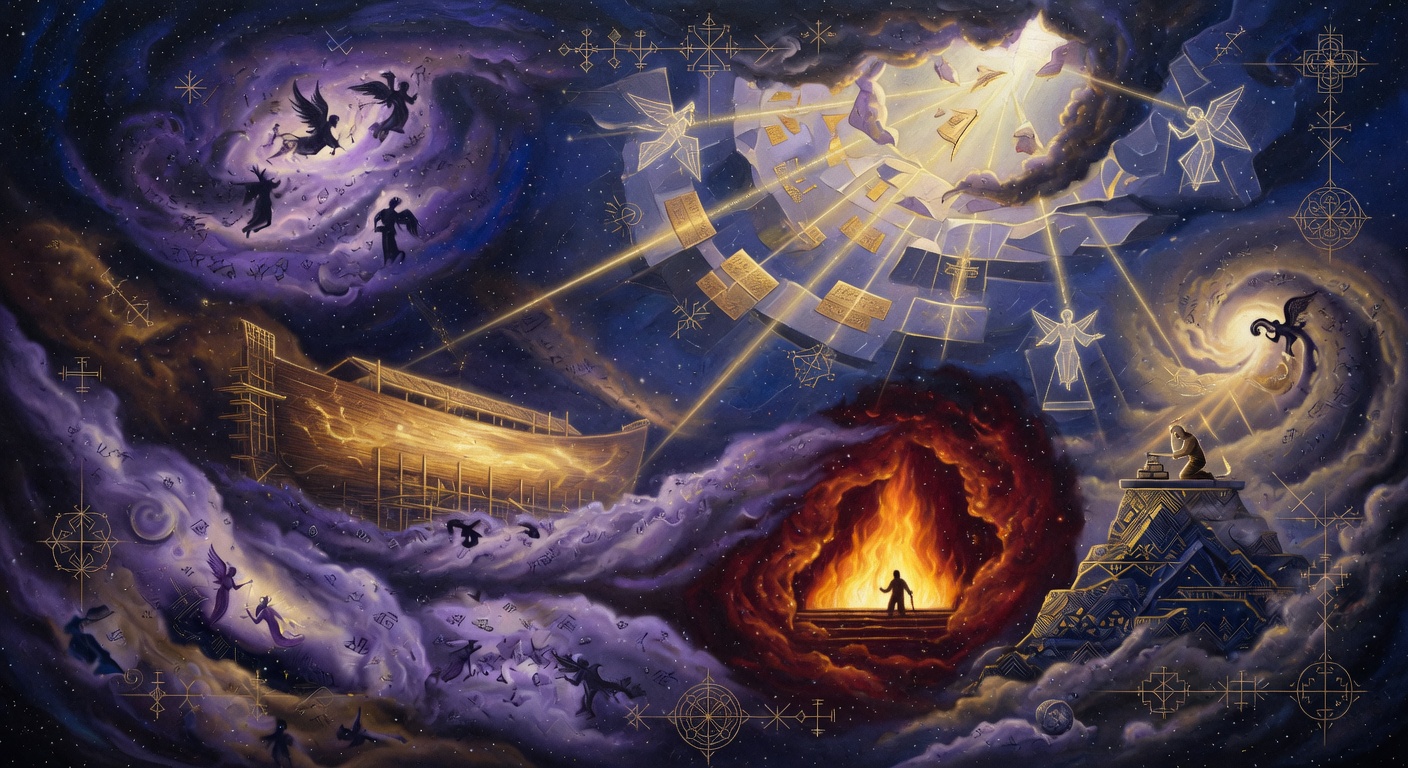
Obedience is the defining virtue of the righteous in these texts - demonstrated through sustained faithfulness under pressure, from Noah's 120 years of building to Abraham's fiery furnace and the binding of Isaac. The pattern repeats across all three books: God tests, the faithful endure, and the result is covenant confirmation. Jubilees presents obedience as alignment with the heavenly tablets - doing what was always ordained. Jasher dramatizes the tests with extended narrative tension. The Enochic tradition frames obedience as the fundamental distinction between the righteous (who maintain their assigned stations) and the wicked (whether angels who descend or humans who rebel). Within the interconnected tradition preserved across the Book of Enoch, the Book of Jubilees, and the Book of Jasher, this concept resonates with broader patterns of divine order, human response, and cosmic consequence. The pseudepigraphal sources provide perspectives and details absent from other ancient texts, offering readers a more complete understanding of how ancient communities understood the relationship between heavenly realities and earthly experience. These expanded accounts invite sustained reflection on the enduring significance of this tradition within the larger framework of Second Temple Jewish thought and its influence on later religious imagination.

0:00

Details

Category
Moral
Key Figures
Abraham, Noah, Moses, Enoch
Passages
3 key references

Key Chapters

Key Passages

Abraham tested by fire

The Book of Jasher 12:1-25

And when the king heard the words of Abram he ordered him to be put into prison; and Abram was ten days in prison....

A1nd when the king heard the words of Abram he ordered him to be put into prison; and Abram was ten days in prison.

2 And at the end of those days the king ordered that all the kings, princes and governors of different provinces and the sages should come before him, and they sat before him, and Abram was still in the house of confinement. 3 And the king said to the princes and sages, Have you heard what Abram, the son of Terah, has done to his father? Thus has he done to him, and I ordered him to be brought before me, and thus has he spoken; his heart did not misgive him, neither did he stir in my presence, and behold now he is confined in the prison. 4 And therefore decide what judgment is due to this man who reviled the king; who spoke and did all the things that you heard. 5 And they all answered the king saying, The man who revileth the king should be hanged upon a tree; but having done all the things that he said, and having despised our gods, he must therefore be burned to death, for this is the law in this matter. 6 If it pleaseth the king to do this, let him order his servants to kindle a fire both night and day in thy brick furnace, and then we will cast this man into it. And the king did so, and he commanded his servants that they should prepare a fire for three days and three nights in the king's furnace, that is in Casdim; and the king ordered them to take Abram from prison and bring him out to be burned. 7 And all the king's servants, princes, lords, governors, and judges, and all the inhabitants of the land, about nine hundred thousand men, stood opposite the furnace to see Abram. 8 And all the women and little ones crowded upon the roofs and towers to see what was doing with Abram, and they all stood together at a distance; and there was not a man left that did not come on that day to behold the scene. 9 And when Abram was come, the conjurors of the king and the sages saw Abram, and they cried out to the king, saying, Our sovereign lord, surely this is the man whom we know to have been the child at whose birth the great star swallowed the four stars, which we declared to the king now fifty years since. 10 And behold now his father has also transgressed thy commands, and mocked thee by bringing thee another child, which thou didst kill. 11 And when the king heard their words, he was exceedingly wroth, and he ordered Terah to be brought before him. 12 And the king said, Hast thou heard what the conjurors have spoken? Now tell me truly, how didst thou; and if thou shalt speak truth thou shalt be acquitted. 13 And seeing that the king's anger was so much kindled, Terah said to the king, My lord and king, thou hast heard the truth, and what the sages have spoken is right. And the king said, How couldst thou do this thing, to transgress my orders and to give me a child that thou didst not beget, and to take value for him? 14 And Terah answered the king, Because my tender feelings were excited for my son, at that time, and I took a son of my handmaid, and I brought him to the king. 15 And the king said Who advised thee to this? Tell me, do not hide aught from me, and then thou shalt not die. 16 And Terah was greatly terrified in the king's presence, and he said to the king, It was Haran my eldest son who advised me to this; and Haran was in those days that Abram was born, two and thirty years old. 17 But Haran did not advise his father to anything, for Terah said this to the king in order to deliver his soul from the king, for he feared greatly; and the king said to Terah, Haran thy son who advised thee to this shall die through fire with Abram; for the sentence of death is upon him for having rebelled against the king's desire in doing this thing. 18 And Haran at that time felt inclined to follow the ways of Abram, but he kept it within himself. 19 And Haran said in his heart, Behold now the king has seized Abram on account of these things which Abram did, and it shall come to pass, that if Abram prevail over the king I will follow him, but if the king prevail I will go after the king. 20 And when Terah had spoken this to the king concerning Haran his son, the king ordered Haran to be seized with Abram. 21 And they brought them both, Abram and Haran his brother, to cast them into the fire; and all the inhabitants of the land and the king's servants and princes and all the women and little ones were there, standing that day over them. 22 And the king's servants took Abram and his brother, and they stripped them of all their clothes excepting their lower garments which were upon them. 23 And they bound their hands and feet with linen cords, and the servants of the king lifted them up and cast them both into the furnace. 24 And the Lord loved Abram and he had compassion over him, and the Lord came down and delivered Abram from the fire and he was not burned. 25 But all the cords with which they bound him were burned, while Abram remained and walked about in the fire.

Binding of Isaac

The Book of Jubilees 18:1-19

And God said to him, 'Abraham, Abraham'; and he said, Behold, (here) am I.'...

A1nd God said to him, 'Abraham, Abraham'; and he said, Behold, (here) am I.'

2 And he said, Take thy beloved son whom thou lovest, (even) Isaac, and go unto the high country, and offer him on one of the mountains which I will point out unto thee.' 3 And he rose early in the morning and saddled his ass, and took his two young men with him, and Isaac his son, and clave the wood of the burnt offering, and he went to the place on the third day, and he saw the place afar off. 4 And he came to a well of water, and he said to his young men, 'Abide ye here with the ass, and I and the lad shall go (yonder), and when we have worshipped we shall come again to you.' 5 And he took the wood of the burnt-offering and laid it on Isaac his son, and he took in his hand the fire and the knife, and they went both of them together to that place. 6 And Isaac said to his father, 'Father;' and he said, 'Here am I, my son.' And he said unto him, 'Behold the fire, and the knife, and the wood; but where is the sheep for the burnt-offering, father?' 7 And he said, 'God will provide for himself a sheep for a burnt-offering, my son.' And he drew near to the place of the mount of God. 8 And he built an altar, and he placed the wood on the altar, and bound Isaac his son, and placed him on the wood which was upon the altar, and stretched forth his hand to take the knife to slay Isaac his son. 9 And I stood before him, and before the prince Mastêmâ, and the Lord said, 'Bid him not to lay his hand on the lad, nor to do anything to him, for I have shown that he fears the Lord.' 10 And I called to him from heaven, and said unto him: 'Abraham, Abraham;' and he was terrified and said: 'Behold, (here) am I.' 11 And I said unto him: 'Lay not thy hand upon the lad, neither do thou anything to him; for now I have shown that thou fearest the Lord, and hast not withheld thy son, thy first-born son, from me.' 12 And the prince Mastêmâ was put to shame; and Abraham lifted up his eyes and looked, and, behold a ram caught . . . by his horns, and Abraham went and took the ram and offered it for a burnt-offering in the stead of his son. 13 And Abraham called that place 'The Lord hath seen', so that it is said in the mount the Lord hath seen: that is Mount Sion. 14 And the Lord called Abraham by his name a second time from heaven, as he caused us to appear to speak to him in the name of the Lord. 15 And he said: 'By Myself have I sworn, saith the Lord, Because thou hast done this thing, And hast not withheld thy son, thy beloved son, from Me, That in blessing I will bless thee, And in multiplying I will multiply thy seed As the stars of heaven, And as the sand which is on the seashore. And thy seed shall inherit the cities of its enemies, 16 And in thy seed shall all nations of the earth be blessed; Because thou hast obeyed My voice, And I have shown to all that thou art faithful unto Me in all that I have said unto thee: Go in peace.' 17 And Abraham went to his young men, and they arose and went together to Beersheba, and Abraham 2010 A.M. dwelt by the Well of the Oath. 18 And he celebrated this festival every year, seven days with joy, and he called it the festival of the Lord according to the seven days during which he went and returned in peace. 19 And accordingly has it been ordained and written on the heavenly tablets regarding Israel and its seed that they should observe this festival seven days with the joy of festival.

Noah obeys

The Book of Jasher 5:10-20

But the sons of men would not hearken to them, nor incline their ears to their words, and they were stiffnecked....

B10ut the sons of men would not hearken to them, nor incline their ears to their words, and they were stiffnecked.

11 And the Lord granted them a period of one hundred and twenty years, saying, If they will return, then will God repent of the evil, so as not to destroy the earth. 12 Noah the son of Lamech refrained from taking a wife in those days, to beget children, for he said, Surely now God will destroy the earth, wherefore then shall I beget children? 13 And Noah was a just man, he was perfect in his generation, and the Lord chose him to raise up seed from his seed upon the face of the earth. 14 And the Lord said unto Noah, Take unto thee a wife, and beget children, for I have seen thee righteous before me in this generation. 15 And thou shalt raise up seed, and thy children with thee, in the midst of the earth; and Noah went and took a wife, and he chose Naamah the daughter of Enoch, and she was five hundred and eighty years old. 16 And Noah was four hundred and ninety-eight years old, when he took Naamah for a wife. 17 And Naamah conceived and bare a son, and he called his name Japheth, saying, God has enlarged me in the earth; and she conceived again and bare a son, and he called his name Shem, saying, God has made me a remnant, to raise up seed in the midst of the earth. 18 And Noah was five hundred and two years old when Naamah bare Shem, and the boys grew up and went in the ways of the Lord, in all that Methuselah and Noah their father taught them. 19 And Lamech the father of Noah, died in those days; yet verily he did not go with all his heart in the ways of his father, and he died in the hundred and ninety-fifth year of the life of Noah. 20 And all the days of Lamech were seven hundred and seventy years, and he died.

Did You Know?

1

Noah builds for 120 years while being mocked - the longest sustained test in the tradition.

2

Abraham's faith is tested by fire (Jasher) before being tested by sacrifice (Jubilees).

3

Moses' patience is formed through 80 years of exile before he's ready for commission.

4

Enoch's faithfulness results in translation - bypassing death entirely as ultimate reward.

5

The Watchers' fall is fundamentally a failure of obedience - abandoning their assigned stations.