Noahic Covenant
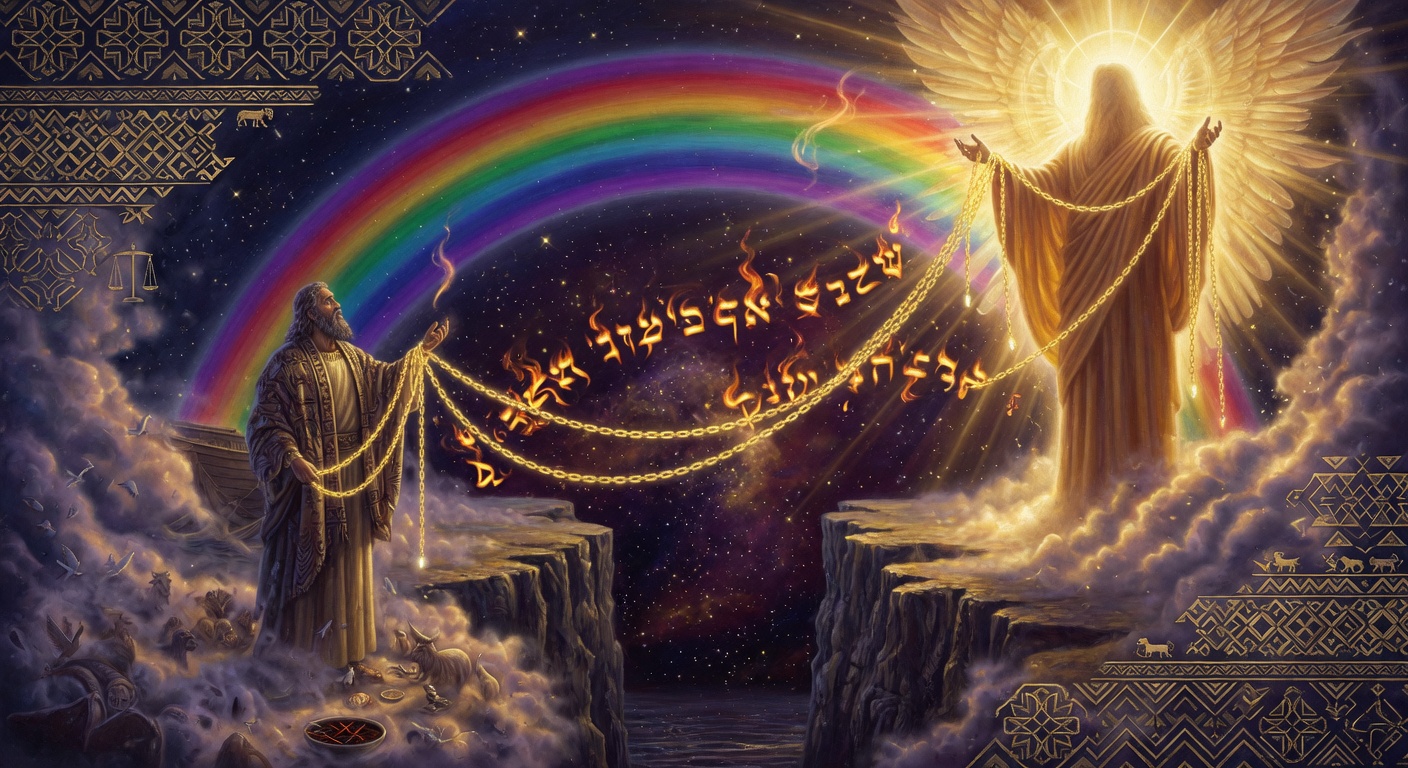
Following the catastrophic deluge that cleansed the earth of the violence and corruption sown by the Watchers, the surviving patriarch Noah receives a divine assurance that reshapes the relationship between heaven and all living creatures. This covenant, recorded most fully in the Book of Jubilees, emerges directly from the Enochic narrative of angelic transgression and its consequences. In Jubilees 6, Noah offers burnt offerings on the renewed altar, prompting God to bind himself by oath never again to destroy the earth by flood, an oath sealed visibly by the rainbow set in the clouds as an eternal sign visible to every generation. The passage underscores that this promise extends not only to humanity but to “all flesh that is on the earth,” establishing a universal order restored after the chaos of the giants and their illicit teachings. The same chapter in Jubilees elaborates the stipulations attached to this covenant, forbidding the consumption of blood because “the blood is the life” and requiring that any shed blood—whether of beast or human—be accounted for through justice. These commands echo the earlier warnings preserved in 1 Enoch 65–67 and 106–107, where Noah is singled out as the righteous remnant spared to perpetuate a purified lineage. The Book of Jasher complements this account by describing Noah’s post-flood ordinances and the solemn renewal of laws governing bloodshed, reinforcing the idea that the covenant reestablishes moral boundaries fractured by the Watchers’ influence. Within the broader Enochic tradition, the Noahic covenant therefore functions as the pivot between antediluvian revelation and the renewed world, guaranteeing cosmic stability while demanding human accountability for life itself. Scholars note that the oath sworn at this moment is presented as eternally binding, observed in heaven and on earth alike, and renewed annually at the Festival of Weeks according to Jubilees 6:17–19. This framework highlights the covenant’s dual character: a divine pledge of restraint paired with enduring ethical imperatives. For readers of the apocryphal corpus, the episode illustrates how the flood judgment ultimately yields not mere survival but a structured peace, symbolized by the rainbow and guarded by laws that prevent the recurrence of the very sins that once provoked heavenly intervention.
Covenant Details
- Parties
- God and Noah/all living creatures
- Sign
- Rainbow
Key Chapters
Key Passages
The Covenant
The Book of Jubilees 6:1-17
 1nd on the new moon of the third month he went forth from the ark, and built an altar on that mountain. And he made atonement for the earth, and took a kid and made atonement by its blood for all the guilt of the earth; for everything that had been on it had been destroyed, save those that were in the ark with Noah. And he placed the fat thereof on the altar, and he took an ox, and a goat, and a sheep and kids, and salt, and a turtle-dove, and the young of a dove, and placed a burnt sacrifice on the altar, and poured thereon an offering mingled with oil, and sprinkled wine and strewed frankincense over everything, and caused a goodly savour to arise, acceptable before the Lord. And the Lord smelt the goodly savour, and He made a covenant with him that there should not be any more a flood to destroy the earth; that all the days of the earth seed-time and harvest should never cease; cold and heat, and summer and winter, and day and night should not change their order, nor cease for ever. 'And you, increase ye and multiply upon the earth, and become many upon it, and be a blessing upon it. The fear of you and the dread of you I will inspire in everything that is on earth and in the sea. And behold I have given unto you all beasts, and all winged things, and everything that moves on the earth, and the fish in the waters, and all things for food; as the green herbs, I have given you all things to eat. But flesh, with the life thereof, with the blood, ye shall not eat; for the life of all flesh is in the blood, lest your blood of your lives be required. At the hand of every man, at the hand of every (beast) will I require the blood of man. Whoso sheddeth man's blood by man shall his blood be shed, for in the image of 9,10 God made He man. And you, increase ye, and multiply on the earth.' And Noah and his sons swore that they would not eat any blood that was in any flesh, and he made a covenant before the
In Jasher
The Book of Jasher 6:1-10
1nd every man made his god and they bowed down to them, and the sons of men forsook the Lord all the days of Enosh and his children; and the anger of the Lord was kindled on account of their works and abominations which they did in the earth.
Did You Know?
The rainbow is the universal sign for all flesh, not just Israel.
Includes the first prohibition against eating blood.