Ark of the Covenant
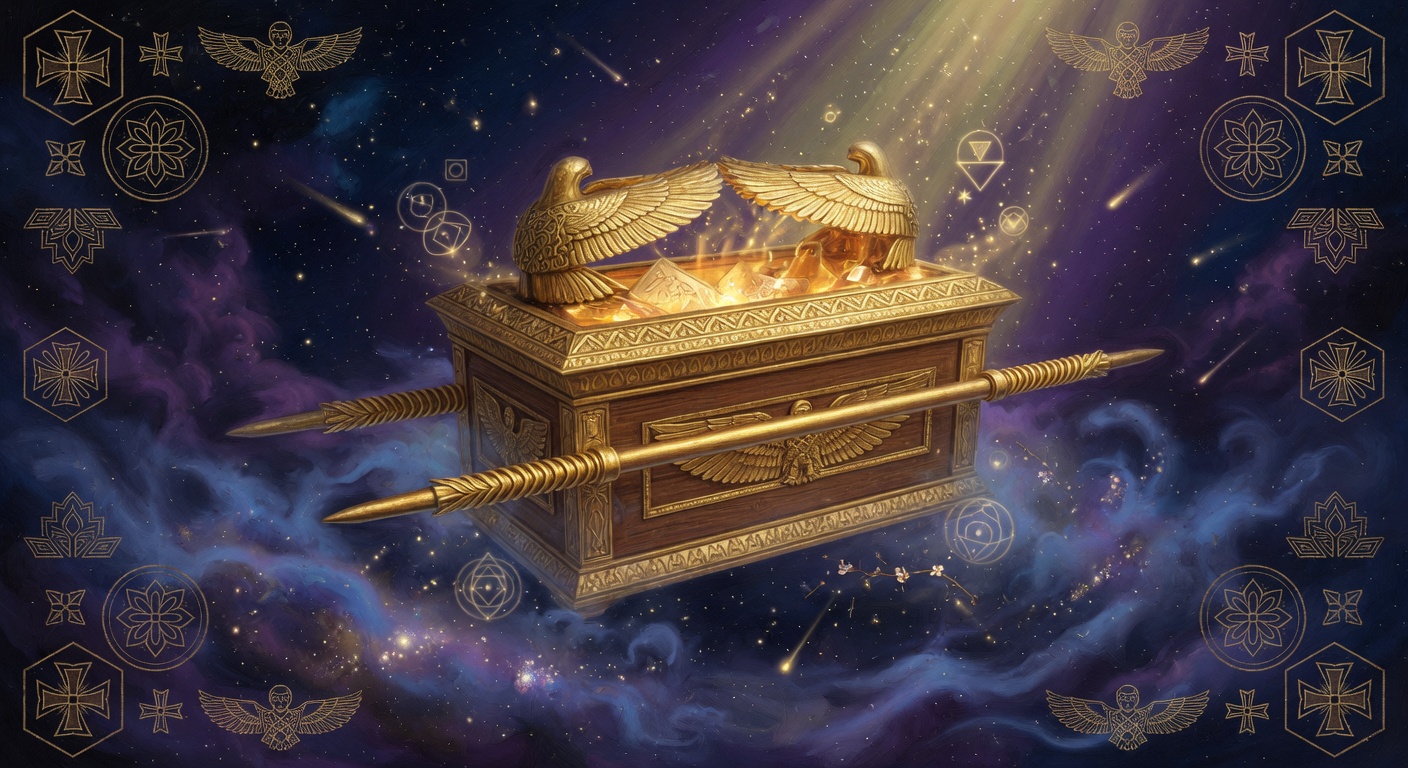
Among the visionary retellings of Israel's foundational history found in Jubilees and Jasher, the sacred chest stands at the center of divine-human encounter, embodying the covenant established at Sinai and extending into the wilderness wanderings. These texts expand upon the biblical framework by emphasizing its role as the earthly counterpart to heavenly realities, much as Enoch's ascents reveal structured celestial realms where divine order is maintained. In Jubilees 49, the instructions for its placement within the tabernacle underscore its function as the locus of atonement and revelation, linking the portable sanctuary directly to the renewal of creation themes woven throughout the book. Construction details receive particular attention in Jasher, where chapters 80 through 82 describe the precise materials and craftsmanship commanded for the acacia wood overlaid with gold, the cherubim figures, and the carrying poles, all executed under Bezalel's direction to ensure ritual purity. These accounts portray the object not merely as a container but as an active instrument in Israel's military campaigns, carried ahead of the people to scatter enemies and affirm divine protection during conflicts with surrounding nations. Such depictions align with Jubilees' broader interest in sacred time and space, presenting the chest as integral to maintaining covenant fidelity across generations. Its contents—the tablets of the Law, Aaron's budding rod, and the jar of manna—receive symbolic elaboration in these writings as tangible witnesses to God's provision and authority. Within the Enochian corpus, parallels emerge through heavenly temple imagery in 1 Enoch 14 and 71, where divine thrones and luminous structures evoke the same sense of mediated presence that the earthly chest was meant to replicate. Together, these texts invite readers to view the artifact as a bridge between primordial wisdom traditions and the ongoing story of Israel's election.
Details
Key Chapters
Key Passages
Construction and Purpose
The Book of Jubilees 1:1-5
 1nd it came to pass in the first year of the exodus of the children of Israel out of Egypt, in the third month, on the sixteenth day of the month, that God spake to Moses, saying: 'Come up to Me on the Mount, and I will give thee two tables of stone of the law and of the commandment, which
In Jasher Narratives
The Book of Jasher 84:1-10
1nd the children of Tubal dwelt in Tuscanah, and their boundaries reached the river Tibreu, and the children of Tubal built a city in Tuscanan, and they called the name Sabinah, after the name of Sabinah son of Tubal their father, and they dwelt there unto this day.
Did You Know?
Jasher gives extended legendary details of its power in battle.
It is the most sacred object in the sanctuary system.
In the Animal Apocalypse (1 Enoch 89), the Ark is symbolized as the house that preserved the 'white bull' (Noah) through the flood waters.
Jubilees specifies that the Ark's placement within the tabernacle must align with the solar calendar's sacred dates.
The cherubim atop the mercy seat face each other with wings spread, creating the space where God's presence dwells between heaven and earth.