๐Ÿ“ข Book audio, podcasts, and more coming soon. Some features are still in development.

Skip to main content

Enslavement of Israel
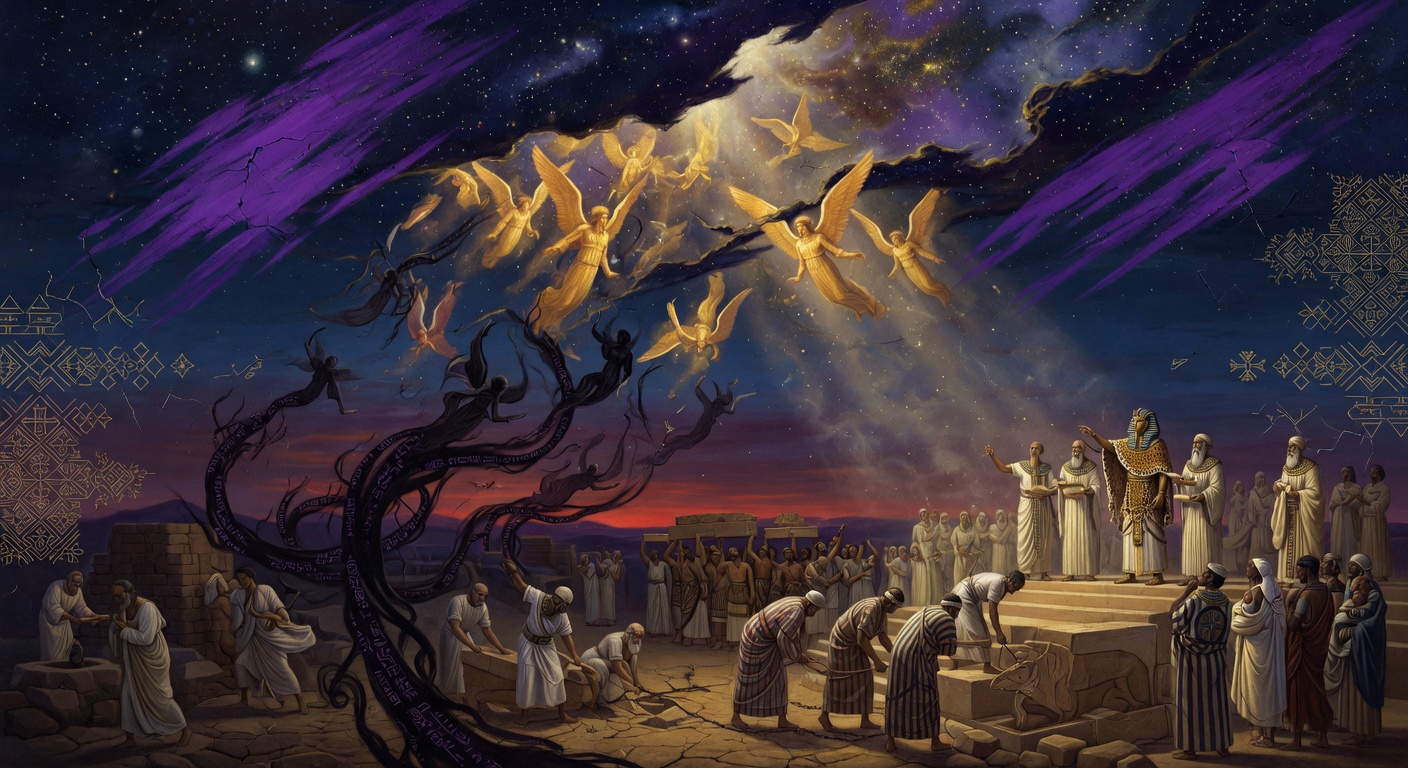
Illustration of Enslavement of Israel
Era
Exodus
Date
Exodus โ—‹ Traditional
Reference
The Book of Jasher 65:1-20

The Enslavement of Israel is the transformation of Jacob's family from honored guests to brutalized slaves under a new Pharaoh who did not know Joseph - a political reversal that sets the stage for the entire Exodus narrative. Jasher 65 provides the most detailed account of the Egyptian elders' conspiracy to reduce Israel through forced labor, describing how they cunningly introduced progressively harder tasks. Jubilees 46 frames the oppression within its chronological scheme, noting that it begins within a generation of Joseph's death. The transition from favor to slavery demonstrates how quickly political memory fades and how covenant promises persist through periods of apparent abandonment. This event represents a critical juncture in the sacred chronology that the Books of Enoch, Jubilees, and Jasher collectively preserve. Within the jubilee framework that Jubilees meticulously tracks, it occupies a precise position in the divine timetable - not an accident of history but a predetermined turning point inscribed on the heavenly tablets before creation. The expanded narratives in Jasher and the theological interpretations in Jubilees together provide a multidimensional understanding of this moment that illuminates both its immediate consequences and its role in the larger pattern of divine action spanning from creation to final judgment.

0:00

Did You Know?

1

The transition from honored guests to slaves happens within a single generation of Joseph's death.

2

Jasher describes the Egyptians using cunning rather than force initially - gradual enslavement.

3

The harder they were pressed, the more they multiplied - oppression produced growth.

4

Jubilees frames the slavery within its precise chronological jubilee framework.

5

Mastema later operates behind Pharaoh's cruelty, adding cosmic warfare to political oppression.

Key Passage

Enslavement of Israel

The Book of Jasher 65:1-20

And it came to pass after these things, that all the counsellors of Pharaoh, king of Egypt, and all the elders of Egypt ...

A1nd it came to pass after these things, that all the counsellors of Pharaoh, king of Egypt, and all the elders of Egypt assembled and came before the king and bowed down to the ground, and they sat before him.

2 And the counsellors and elders of Egypt spoke unto the king, saying, 3 Behold the people of the children of Israel is greater and mightier than we are, and thou knowest all the evil which they did to us in the road when we returned from battle. 4 And thou hast also seen their strong power, for this power is unto them from their fathers, for but a few men stood up against a people numerous as the sand, and smote them at the edge of the sword, and of themselves not one has fallen, so that if they had been numerous they would then have utterly destroyed them. 5 Now therefore give us counsel what to do with them, until we gradually destroy them from amongst us, lest they become too numerous for us in the land. 6 For if the children of Israel should increase in the land, they will become an obstacle to us, and if any war should happen to take place, they with their great strength will join our enemy against us, and fight against us, destroy us from the land and go away from it. 7 So the king answered the elders of Egypt and said unto them, This is the plan advised against Israel, from which we will not depart, 8 Behold in the land are Pithom and Rameses, cities unfortified against battle, it behooves you and us to build them, and to fortify them. 9 Now therefore go you also and act cunningly toward them, and proclaim a voice in Egypt and in Goshen at the command of the king, saying, 10 All ye men of Egypt, Goshen, Pathros and all their inhabitants! the king has commanded us to build Pithom and Rameses, and to fortify them for battle; who amongst you of all Egypt, of the children of Israel and of all the inhabitants of the cities, are willing to build with us, shall each have his wages given to him daily at the king's order; so go you first and do cunningly, and gather yourselves and come to Pithom and Rameses to build. 11 And whilst you are building, cause a proclamation of this kind to be made throughout Egypt every day at the command of the king. 12 And when some of the children of Israel shall come to build with you, you shall give them their wages daily for a few days. 13 And after they shall have built with you for their daily hire, drag yourselves away from them daily one by one in secret, and then you shall rise up and become their task-masters and officers, and you shall leave them afterward to build without wages, and should they refuse, then force them with all your might to build. 14 And if you do this it will be well with us to strengthen our land against the children of Israel, for on account of the fatigue of the building and the work, the children of Israel will decrease, because you will deprive them from their wives day by day. 15 And all the elders of Egypt heard the counsel of the king, and the counsel seemed good in their eyes and in the eyes of the servants of Pharaoh, and in the eyes of all Egypt, and they did according to the word of the king. 16 And all the servants went away from the king, and they caused a proclamation to be made in all Egypt, in Tachpanches and in Goshen, and in all the cities which surrounded Egypt, saying, 17 You have seen what the children of Esau and Ishmael did to us, who came to war against us and wished to destroy us. 18 Now therefore the king commanded us to fortify the land, to build the cities Pithom and Rameses, and to fortify them for battle, if they should again come against us. 19 Whosoever of you from all Egypt and from the children of Israel will come to build with us, he shall have his daily wages given by the king, as his command is unto us. 20 And when Egypt and all the children of Israel heard all that the servants of Pharaoh had spoken, there came from the Egyptians, and the children of Israel to build with the servants of Pharaoh, Pithom and Rameses, but none of the children of Levi came with their brethren to build.

Read full chapter: The Book of Jasher 65 โ†’

Did You Know?

1

The transition from honored guests to slaves happens within a single generation of Joseph's death.

2

Jasher describes the Egyptians using cunning rather than force initially - gradual enslavement.

3

The harder they were pressed, the more they multiplied - oppression produced growth.

4

Jubilees frames the slavery within its precise chronological jubilee framework.

5

Mastema later operates behind Pharaoh's cruelty, adding cosmic warfare to political oppression.