The Golden Calf
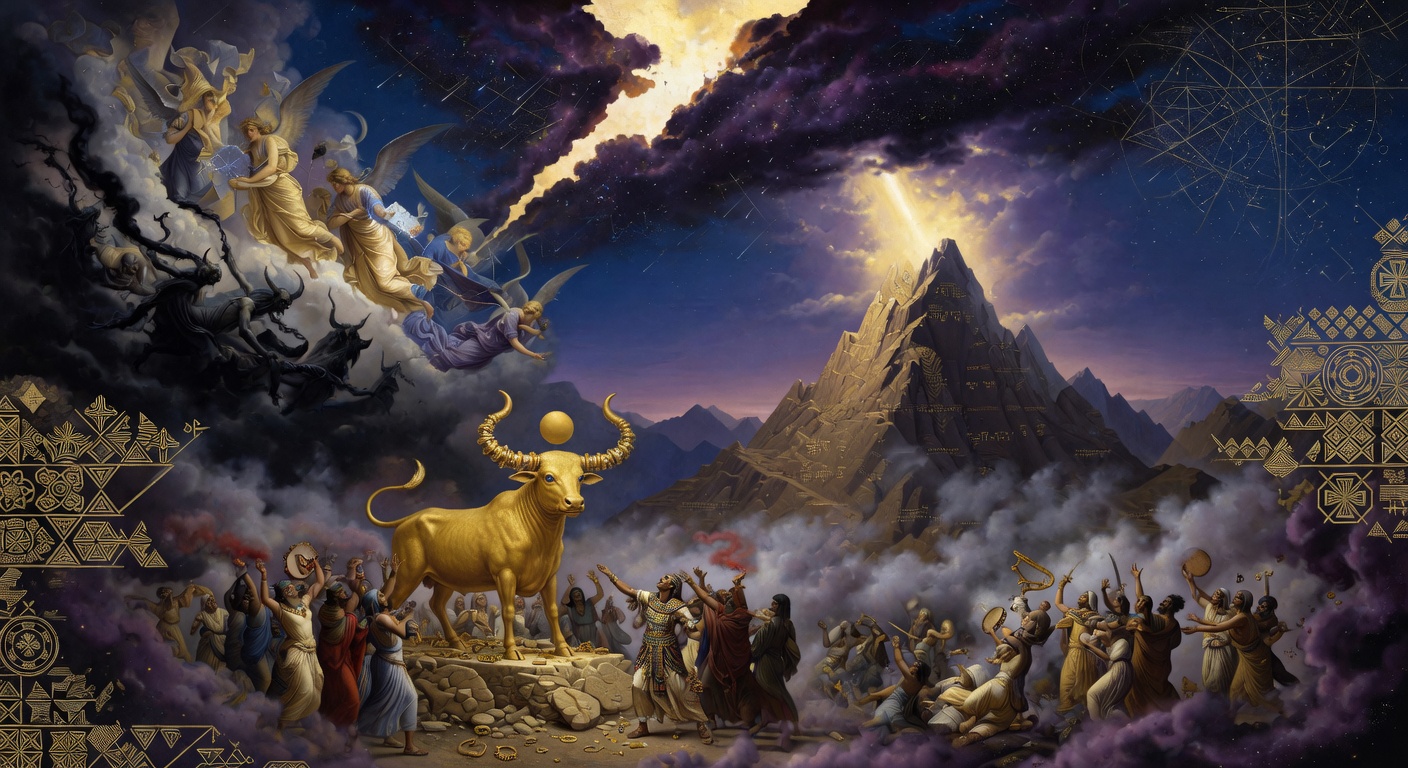
The Golden Calf is Israel's catastrophic failure at the foot of Sinai - fashioning and worshiping an idol while Moses received the Law on the mountain above, demonstrating how quickly liberated people revert to the corrupted worship patterns that trace back to the Watchers' era. Jasher 82 provides the narrative context, describing Aaron's capitulation under pressure and the subsequent civil conflict. Within the broader tradition, the episode illustrates the persistent pull of idolatry that Abraham had rejected generations earlier, proving that external deliverance from Egypt did not automatically produce internal transformation. This event represents a critical juncture in the sacred chronology that the Books of Enoch, Jubilees, and Jasher collectively preserve. Within the jubilee framework that Jubilees meticulously tracks, it occupies a precise position in the divine timetable - not an accident of history but a predetermined turning point inscribed on the heavenly tablets before creation. The expanded narratives in Jasher and the theological interpretations in Jubilees together provide a multidimensional understanding of this moment that illuminates both its immediate consequences and its role in the larger pattern of divine action spanning from creation to final judgment.
Did You Know?
The calf is made while Moses is literally receiving the commandments on the mountain above.
Aaron fashions it under popular pressure, demonstrating how leadership can fail.
The episode proves external liberation from Egypt did not transform internal disposition.
Civil conflict follows - tribe against tribe over the idol.
The pattern of idol worship traces back to the corrupted teachings of the Watchers.
Key Passage
The Golden Calf
The Book of Jasher 82:15-25
And the Lord said to Moses, before he had come down from the mount, Get thee down, for thy people whom thou didst bring ...
 15nd the Lord said to Moses, before he had come down from the mount, Get thee down, for thy people whom thou didst bring forth from Egypt have corrupted themselves.
Did You Know?
The calf is made while Moses is literally receiving the commandments on the mountain above.
Aaron fashions it under popular pressure, demonstrating how leadership can fail.
The episode proves external liberation from Egypt did not transform internal disposition.
Civil conflict follows - tribe against tribe over the idol.
The pattern of idol worship traces back to the corrupted teachings of the Watchers.