The Burning Bush
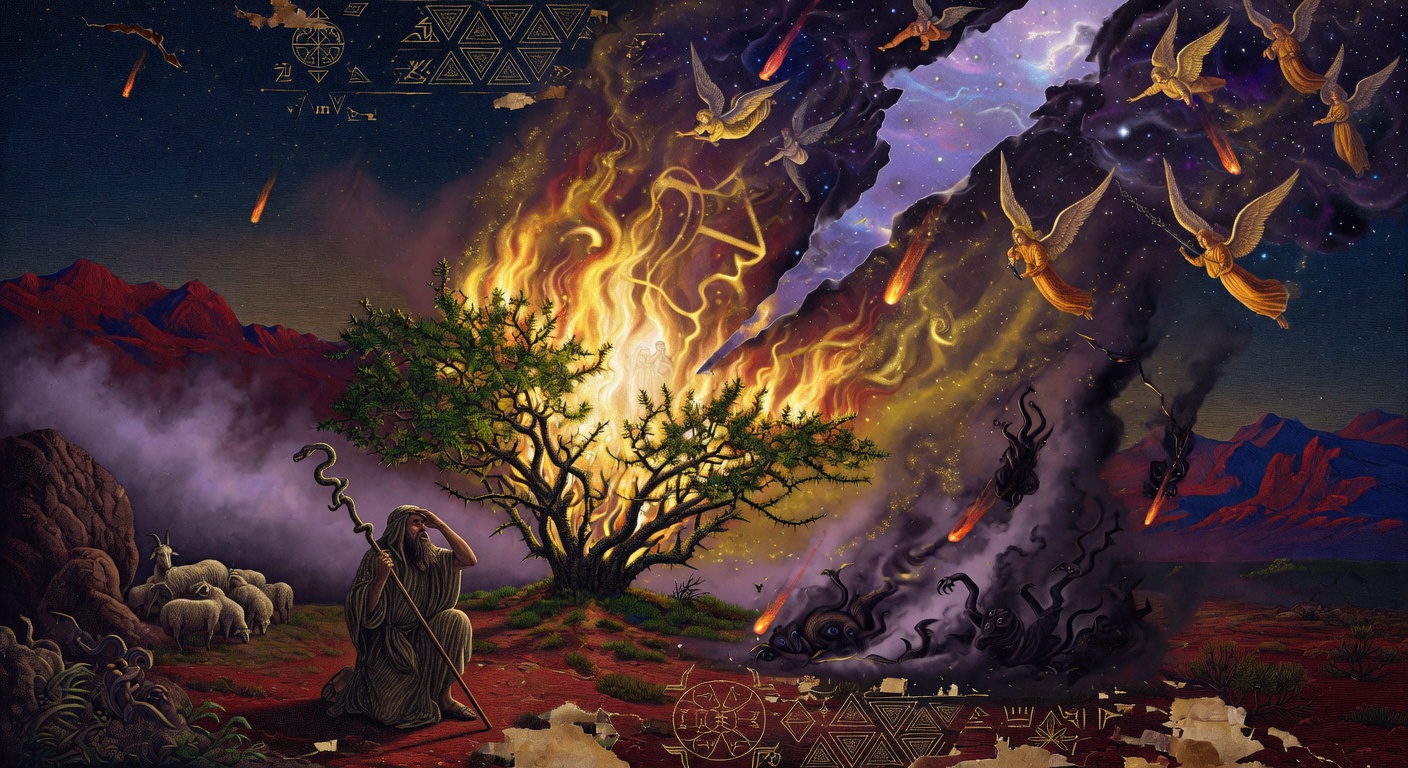
The Burning Bush is God's direct appearance to Moses in the wilderness of Midian - a fire that burns without consuming, from which the divine voice commissions the reluctant shepherd to return to Egypt and deliver Israel from bondage. Jasher 79 describes the encounter after Moses has spent years tending Reuel's flocks in the wilderness. The bush that burns without being consumed demonstrates that divine presence can inhabit creation without destroying it. Moses receives his commission, his staff becomes a sign, and Aaron is appointed as his spokesman. This theophany bridges the forty years of preparation with the confrontation with Pharaoh that will follow. This event represents a critical juncture in the sacred chronology that the Books of Enoch, Jubilees, and Jasher collectively preserve. Within the jubilee framework that Jubilees meticulously tracks, it occupies a precise position in the divine timetable - not an accident of history but a predetermined turning point inscribed on the heavenly tablets before creation. The expanded narratives in Jasher and the theological interpretations in Jubilees together provide a multidimensional understanding of this moment that illuminates both its immediate consequences and its role in the larger pattern of divine action spanning from creation to final judgment.
Did You Know?
The fire burns without consuming the bush - divine presence inhabits creation without destroying it.
Moses is told to remove his sandals because the ground is holy - sacred space exists in wilderness.
His staff becomes the instrument of signs throughout the entire Exodus narrative.
Aaron is appointed as spokesman because Moses claims difficulty speaking.
The divine name is revealed here - connecting identity to the commissioning.
Key Passage
The Burning Bush
The Book of Jasher 79:1-20
And in those days Moses was feeding the flock of Reuel the Midianite his father-in-law, beyond the wilderness of Sin, an...
 1nd in those days Moses was feeding the flock of Reuel the Midianite his father-in-law, beyond the wilderness of Sin, and the stick which he took from his father-in-law was in his hand.
Did You Know?
The fire burns without consuming the bush - divine presence inhabits creation without destroying it.
Moses is told to remove his sandals because the ground is holy - sacred space exists in wilderness.
His staff becomes the instrument of signs throughout the entire Exodus narrative.
Aaron is appointed as spokesman because Moses claims difficulty speaking.
The divine name is revealed here - connecting identity to the commissioning.